Testing NVIDIA's Document-AI Adaptation Release Against Prompting With a Template-Held-Out Split
On this page
Introduction: Make Adaptation Beat a Strong Prompting Baseline Before Adopting It
The Engineering Decision: Does Adaptation Beat Prompting on Unseen Templates?
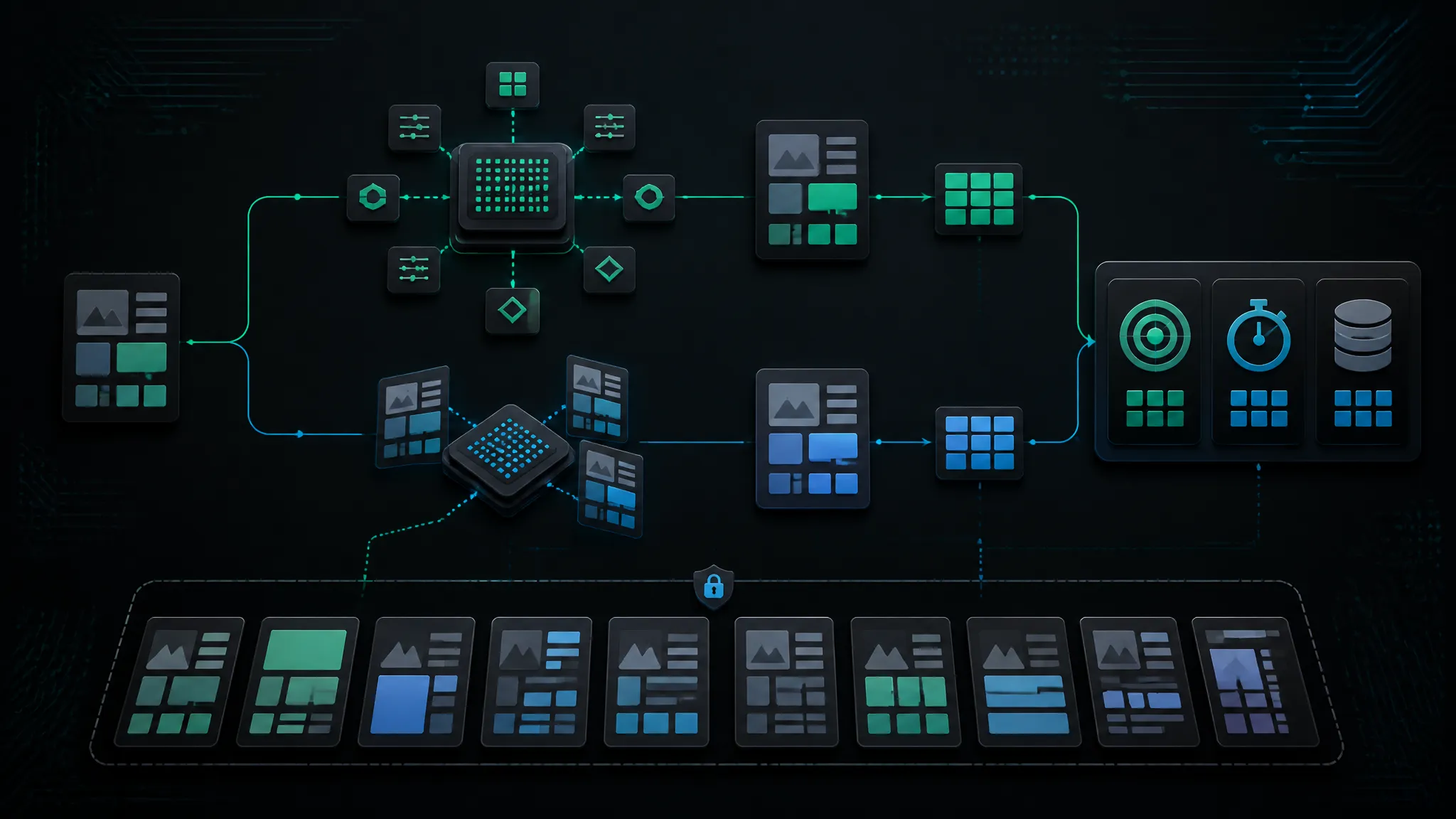
This post is a practical workflow for testing NVIDIA's document-AI adaptation release against prompting with a template-held-out split, so you can compare extraction accuracy, latency, and deployment cost before committing to fine-tuning. The goal is a decision-grade comparison, not a demo.
Suppose the supplied report is correct and someone hands you a training dataset and tooling for adapting a document-reading model. The question you actually have to answer isn't "can we fine-tune this?" It's "does adaptation beat the best prompt-only system we can build, on templates the model has never seen, by enough to pay for training, serving, and maintenance?"
That's a narrower question, and it has a measurable answer. Adapting a model changes the artifact you deploy: you now own a checkpoint, a training configuration, a data pipeline, and a refresh process. Prompting changes a string. The operational surface area is very different, so the evidence bar for adaptation should be high. My position up front: default to the simplest system that clears your requirements on unseen document templates, and only pay for adaptation when a template-held-out comparison shows a gain that survives latency, cost, and safety gates.
The failure mode this workflow is meant to prevent: a team fine-tunes on documents from the same templates it later evaluates on, sees a large jump, ships, and then finds the gain was memorization of layout rather than better extraction.
Establish What the Release Evidence Actually Confirms
What the supplied material actually confirms is thin. I want to be precise about it:
| Claim | Status |
|---|---|
| A Superpower Daily item dated 2026-11-26 is headlined "NVIDIA releases training data and tools to adapt its document-reading AI" | Confirmed — this is the supplied snippet |
| NVIDIA released training data and tooling for adapting a document-reading model | Reported by the secondary source; not independently verified here |
| Which model, which dataset, license terms, adaptation method, hardware requirements | Not stated in the supplied material |
| Any accuracy, latency, or cost improvement | Not stated in the supplied material |
The snippet is a headline. It doesn't name a model, a dataset license, a fine-tuning method, a supported document format, or a GPU requirement. Any post that fills those blanks in from memory is inventing details. So this post treats the release as an unverified candidate and defines the verification gate and benchmark you'd run once the artifacts are in hand.
Don't plan a training run against a release described only by a headline. Model name, license, and hardware requirements are the three facts that decide whether a project is feasible at all, and none of them are in the supplied source.
Proposed Benchmark vs. Completed Experiment
Everything below is a method, not a result. No NVIDIA model was run for this post, no accuracy figure is reported as measured, and no hardware requirement is claimed. Where a number appears, it's either a fixture value from synthetic data, an arithmetic example explicitly labeled hypothetical, or a table cell marked not measured.
That distinction matters more in AI writing than anywhere else, because benchmark numbers are cheap to fabricate and expensive to disprove. A reader should be able to tell, from the text alone, which sentences came from a run and which came from a plan.
Verify the NVIDIA Release Before Choosing an Adaptation Path
Locate the primary artifacts and the real release date
A secondary publication date is not a launch date. The item is dated 2026-11-26; the release it describes could be days or weeks older, and that difference matters when you're trying to pin down which checkpoint or dataset revision you're evaluating.
Before writing a line of training code, collect:
- the official announcement post from the vendor,
- the model card for the specific checkpoint being adapted,
- the dataset card describing composition, collection method, and known limitations,
- the training repository or CLI that implements the documented adaptation method,
- the license file for the weights and, separately, for the data,
- the supported-input documentation (file types, max pages, image DPI, language coverage).
If any of those is missing, you're looking at a press release, not a reproducible workflow. Record what you found and what you couldn't find. The second list is what will bite you later.
Record versions, supported inputs, outputs, and hardware
Pin facts into a config file, not someone's memory. The minimum set:
## release-pin.yaml — fill from primary artifacts only
release:
  announcement_url: ""        # verified vendor URL
  announcement_date: ""       # actual date, not the news aggregator date
  model_name: ""
  model_revision: ""
  training_repo_commit: ""
  dataset_name: ""
  dataset_revision: ""
licensing:
  weights_license: ""
  dataset_license: ""
  commercial_use: "unknown"   # allowed / restricted / unknown
  redistribution: "unknown"
inputs:
  file_types: []
  max_pages: null
  min_render_dpi: null
  languages_documented: []
outputs:
  format: ""
  schema_control: "unknown"   # does the model support caller-supplied schemas?
adaptation:
  methods_documented: []      # lora / full fine-tune / adapter / other
  annotation_format: ""
hardware:
  training_gpu_class: ""
  min_vram_gb: null
  serving_gpu_class: ""
Every value must trace back to a primary document. unknown is acceptable; a guess is not.
Check the licenses before you touch sensitive documents
Two licenses govern this decision and people routinely conflate them:
- Weights license — can you use the adapted checkpoint commercially, and can you redistribute it to a customer environment?
- Data license — can the training corpus be used to produce a derivative model, and does it carry restrictions on redistribution or on specific downstream uses?
There's a third question the license file won't answer: whether your own documents are permitted to leave your environment for training. Invoices, medical records, and contracts usually carry contractual or statutory constraints that a vendor license cannot override. If the documented adaptation path requires uploading customer documents to a managed endpoint, that may end the evaluation regardless of accuracy.
Apply the feasibility gate
Before any modeling work, answer these four yes/no:
- Artifacts present? Model card, dataset card, training repo, license — all located.
- License compatible? Commercial use, redistribution (if needed), and data-handling terms all permit the intended deployment.
- Hardware reachable? Documented training requirements fit infrastructure you can actually obtain, not infrastructure you could theoretically rent.
- Method documented enough to reproduce? Someone outside the vendor could follow the instructions and get a working checkpoint.
A single "no" on the first three stops the project. A "no" on the fourth means you can still run a prompting comparison — you just can't run the adaptation arm, and you should say so instead of hand-waving a training plan.
Define a Document-Extraction Task With an Auditable Success Criterion
Choose a bounded extraction task
Invoices are a decent first target: rigid schema, known failure modes, and line items that force you to score structured sub-objects rather than a flat bag of fields.
Pin the schema down to types, nullability, and semantics:
{
  "invoice_number": "string | null",
  "issue_date": "ISO-8601 date | null",
  "currency": "ISO-4217 code | null",
  "subtotal": "decimal string | null",
  "tax_total": "decimal string | null",
  "total": "decimal string | null",
  "line_items": [
    {
      "description": "string | null",
      "quantity": "decimal string | null",
      "unit_price": "decimal string | null",
      "amount": "decimal string | null"
    }
  ]
}
The null semantics are where benchmarks quietly cheat. Decide and write down: does null mean "not present on the document" or "present but unreadable"? If a value is present in the JSON but not on the document, is that a fabrication error, an unsupported-populated-value error, or just noise? Score them separately. Fabrication is the one that breaks downstream systems.
Build adjudicated ground truth
Ground truth is the expensive part, and it decides whether any of this is credible.
- Two annotators, one adjudicator. Double-annotate a subset and report disagreement; if field-level disagreement exceeds roughly 2%, your schema or rules are ambiguous, not your annotators.
- Annotation rules as a document. Currency symbol inference, dates written as
03/04/26, totals that disagree with line-item sums — each needs a written rule. - Ambiguity flags. Some documents genuinely don't contain a value. Flag them so the scorer doesn't punish a correct
null. - Reference into the source. For every non-null label, store the page and bounding box so a reviewer can check the value without re-reading the whole PDF.
- Label version.
labels-2026-11-18is a version; "the labels" is not. Changing labels after seeing results invalidates the comparison.
Predeclare counts, thresholds, and limits
Write the acceptance criteria before seeing any output:
| Item | Predeclared value |
|---|---|
| Documents in test partition | 150 (example target) |
| Template families in test partition | 30 (example target) |
| Required fields per document | 6 header fields + line items |
| Maximum document-level exact-match regression vs baseline | 0 points |
| Minimum document-level exact-match gain to justify adaptation | +5 points absolute |
| Fabrication (unsupported populated value) rate ceiling | 0.5% of populated fields |
| p95 end-to-end latency ceiling | 4.0 s |
| Cost ceiling per accepted document | defined per workload |
Those numbers are placeholders you replace with your own. The point is they exist before the run, in a file, with a date. A threshold chosen after seeing results isn't a threshold.
State what the benchmark does not establish
Be explicit in the write-up: results on 150 synthetic-heavy English invoices from 30 template families tell you nothing about handwritten receipts, multi-language documents, rotated phone photos, or 40-page statements. Say that in one paragraph rather than letting a reader generalize from a number you reported carefully.
Build a Template-Held-Out Split That Resists Leakage
Define template families, not folders
A template family is a group of documents that share layout structure, issuer, and form revision. Two invoices from the same vendor's same ERP export are the same family even if filenames differ, dates differ, and one is a rescan.
Practical grouping signals, roughly in order of usefulness:
- Layout skeleton — approximate positions of header blocks, table columns, footer elements.
- Issuer/vendor identity — the entity that generated the form, not the entity it's addressed to.
- Form revision — a visible form version, or a change in field set over time.
- Provenance — the process that produced the file (ERP export, scanner batch, synthetic generator).
Filenames are the weakest signal, and the one people default to. invoice_2026_03_04_v2.pdf tells you nothing about layout.
Detect duplicates and near-duplicates first
Leakage usually enters through the back door:
- the same PDF included twice under different names,
- a rescan of the same physical document at a different DPI,
- a synthetic variant of a training document with a perturbed date,
- an original and its OCR'd text layer stored as separate files.
Byte hashes catch exact duplicates. For near-duplicates, compare normalized page-image perceptual hashes or normalized text shingles, and require that any group of near-duplicates lives entirely inside one partition. This is clustering, not filtering: you group, then assign groups.
Assign whole families; audit vendor overlap
Partition at the family level. Then run a stricter check: does any vendor appear in both train and test? The family split allows that, but it still lets the model memorize a vendor's typography, logo, and field conventions. Run both and report both:
- Family-held-out — the primary result. Every test family is unseen.
- Vendor-held-out — the strict result. No vendor appears in both train and test.
If the strict number is much worse than the primary number, you've measured vendor memorization and should report it as such.
Keep prompts and adaptation data inside train
Few-shot prompt examples are training data. If your few-shot examples come from validation or test templates, the prompting baseline is contaminated and the comparison is dead. Same for retrieved exemplars, template-specific post-processing rules, and any threshold tuned on validation.
The discipline:
| Artifact | Allowed source |
|---|---|
| Few-shot prompt examples | train families only |
| Adaptation/training data | train families only |
| Thresholds, retry policy, decoding settings | validation families |
| Final reported numbers | test families, evaluated once |
Add a seen-template slice as a diagnostic
Include a small slice of test-partition documents drawn from train families. Report it separately, clearly labeled seen-template diagnostic. It's useful — it tells you whether the model is learning field semantics at all — but it's never the headline number. Confusing the two is the most common way document-AI adaptation gets oversold.
Implement a Reproducible Dataset and Split Audit
A manifest that survives an audit
One JSON manifest per split version, containing everything needed to reconstruct the partition without touching the documents:
{
  "manifestVersion": "2026-11-01.1",
  "splitSeed": "fixture-seed-0001",
  "documents": [
    {
      "id": "inv-0003",
      "file": "documents/inv-0003.pdf",
      "sha256": "9f2c1ab7c4d0",
      "templateFamily": "fam-0041",
      "vendor": "acme-corp",
      "pages": 2,
      "quality": "clean-scan",
      "language": "en",
      "annotationVersion": "labels-2026-11-18",
      "partition": "train"
    }
  ]
}
Hash values in this post are truncated fixture values from synthetic documents. The real manifest stores full digests.
A split-audit script that fails loudly
#!/usr/bin/env node
// split-audit.mjs - reject duplicate content and template-family leakage across partitions


const PARTITIONS = new Set(["train", "validation", "test"]);
const REQUIRED = ["id", "file", "sha256", "templateFamily", "vendor", "partition"];

const manifestPath = process.argv[2];
if (!manifestPath) {
  console.error("usage: node split-audit.mjs <manifest.json>");
  process.exit(2);
}

const manifest = JSON.parse(readFileSync(manifestPath, "utf8"));
const documents = manifest.documents ?? [];
const errors = [];
const warnings = [];

const index = (map, key, doc) => {
  if (!map.has(key)) map.set(key, []);
  map.get(key).push(doc);
};

const byHash = new Map();
const byFamily = new Map();
const byVendor = new Map();
const counts = { train: 0, validation: 0, test: 0 };

for (const doc of documents) {
  const id = doc.id ?? "<no-id>";

  for (const key of REQUIRED) {
    if (!doc[key]) errors.push(["missing-field", id, key].join("\t"));
  }

  if (!PARTITIONS.has(doc.partition)) {
    errors.push(["bad-partition", id, String(doc.partition)].join("\t"));
    continue;
  }
  counts[doc.partition] += 1;

  let actual = null;
  try {
    actual = createHash("sha256").update(readFileSync(doc.file)).digest("hex");
  } catch {
    errors.push(["unreadable-file", id, doc.file].join("\t"));
  }

  if (actual && doc.sha256 && actual !== doc.sha256) {
    errors.push(
      ["hash-mismatch", id, "declared=" + doc.sha256.slice(0, 12), "actual=" + actual.slice(0, 12)].join("\t")
    );
  }

  index(byHash, actual ?? doc.sha256 ?? id, doc);
  index(byFamily, doc.templateFamily, doc);
  index(byVendor, doc.vendor, doc);
}

for (const [hash, docs] of byHash) {
  if (docs.length > 1) {
    errors.push(
      ["duplicate-content", docs.map((d) => d.id).sort().join(","), hash.slice(0, 12)].join("\t")
    );
  }
}

for (const [family, docs] of byFamily) {
  const parts = [...new Set(docs.map((d) => d.partition))].sort();
  if (parts.length > 1) {
    errors.push(["family-leak", family, parts.join("+"), docs.map((d) => d.id).sort().join(",")].join("\t"));
  }
}

for (const [vendor, docs] of byVendor) {
  const parts = new Set(docs.map((d) => d.partition));
  if (parts.has("train") && parts.has("test")) {
    warnings.push(["vendor-overlap", vendor, "train+test"].join("\t"));
  }
}

errors.sort();
warnings.sort();

console.log("split-audit: " + manifestPath);
console.log(
  "documents: " + documents.length +
  " (train=" + counts.train + ", validation=" + counts.validation + ", test=" + counts.test + ")"
);
console.log("template families: " + byFamily.size);
console.log("errors: " + errors.length);
for (const line of errors) console.log("  " + line);
console.log("warnings: " + warnings.length);
for (const line of warnings) console.log("  " + line);

process.exit(errors.length > 0 ? 1 : 0);
Note what it doesn't do: it never prints document contents, extracted text, or field values. Only IDs, family names, and truncated hash prefixes. An audit log that leaks invoice data is its own incident.
Run it on a clean and a contaminated fixture
node fixtures/make-fixtures.mjs          # writes 12 synthetic PDFs + 2 manifests
node split-audit.mjs fixtures/manifest-clean.json
node split-audit.mjs fixtures/manifest-leaky.json
Expected output, clean fixture (synthetic documents, generated by the command above):
split-audit: fixtures/manifest-clean.json
documents: 12 (train=6, validation=3, test=3)
template families: 6
errors: 0
warnings: 1
  vendor-overlap	acme-corp	train+test
Expected output, deliberately contaminated fixture — inv-0009 is a rescan of inv-0003, fam-0041 spans train and test, and inv-0005's declared hash does not match the file:
split-audit: fixtures/manifest-leaky.json
documents: 12 (train=6, validation=3, test=3)
template families: 6
errors: 3
  duplicate-content	inv-0003,inv-0009	9f2c1ab7c4d0
  family-leak	fam-0041	test+train	inv-0007,inv-0011
  hash-mismatch	inv-0005	declared=41b8e0d3a991	actual=2c77fa90be03
warnings: 1
  vendor-overlap	acme-corp	train+test
Exit code is 1. Wire this into CI so a manifest change that reintroduces leakage fails the build instead of the launch.
## .github/workflows/split-audit.yml (excerpt)
- run: node split-audit.mjs manifests/current.jsonShip the contaminated fixture as a test case. A validator that has never been seen to fail is indistinguishable from one that does nothing.
Preserve seeds, hashes, and access control
Store the split seed, manifest hash, fixture generator version, and annotation version together. Then treat the test partition as a sealed dataset: restricted bucket, access log, and a rule that nobody inspects test documents while iterating. If a human looks at test failures and changes a prompt because of them, the test set has become a validation set and the final number is no longer held out.
Establish Prompting Baselines Before Training
Zero-shot and few-shot, both frozen
Two baselines, both cheap, both necessary:
- Zero-shot — a fixed instruction block that includes the JSON schema and null semantics, with no examples.
- Few-shot — the same instruction block plus k examples retrieved from train families only.
Few-shot is the baseline that actually matters, because it's the system you'd ship if you didn't adapt. A fine-tune that beats zero-shot but loses to few-shot is not an improvement.
Freeze the whole pipeline, not just the prompt
Hold constant across arms:
- the schema text and field descriptions,
- page rendering (DPI, color mode), and any OCR step with its version pinned,
- decoding settings (temperature, max tokens, stop conditions),
- retry rules and timeout budget,
- output validation and repair behavior.
If the adapted arm gets a different renderer than the prompted arm, you're comparing OCR pipelines. That's a legitimate system comparison — label it as one rather than attributing the delta to adaptation.
Same base checkpoint, or call it a system comparison
Prompting and adaptation should use the same base checkpoint where the release supports it. If the only served endpoint differs from the checkpoint you can adapt, you're comparing two systems and cannot isolate the adaptation effect. Say that in the write-up. Reviewers forgive a system comparison; they don't forgive one described as an ablation.
Separate controlled from end-to-end comparisons
| Comparison type | What varies | What it can claim |
|---|---|---|
| Controlled model comparison | prompt vs checkpoint, same preprocessing | effect of adaptation on this task |
| System comparison | endpoint version, OCR, resolution | which deployable system is better end to end |
Both are useful. Only the first supports the sentence "fine-tuning improved extraction by N points."
Adapt the Verified NVIDIA Model With a Controlled Training Run
Convert annotations and inspect before launching
Whatever annotation format the release documents, convert from your adjudicated labels rather than from raw model output. Training on your own predictions amplifies existing errors. Then print three converted examples in full and read them. Schema drift between your labels and the training format is the usual cause of a run that trains cleanly and predicts garbage.
node convert-annotations.mjs \
  --labels labels/labels-2026-11-18.jsonl \
  --partition train \
  --format <documented-format> \
  --out data/train.jsonl
node inspect-examples.mjs --input data/train.jsonl --count 3
Follow the supported method and record lineage
Use the officially documented adaptation method. Don't substitute your own training loop on an unfamiliar checkpoint. Whatever you run, record:
- trainable parameter count (full fine-tune vs adapter vs LoRA rank),
- optimizer, learning rate, schedule, warmup,
- steps, effective batch size, gradient accumulation,
- seed, precision (bf16/fp16/fp32), gradient checkpointing,
- base checkpoint digest → output checkpoint digest,
- the exact training data manifest hash.
That lineage is what lets you answer "which checkpoint was in production on which date" six months later, when template drift appears.
Select checkpoints on validation templates only
Pick the checkpoint by validation-partition performance, evaluated at a few fixed step counts. Don't select on training loss — it will keep improving while layout generalization doesn't. And don't repeatedly score checkpoints against the test partition; every such look burns a unit of held-out credibility.
Count the real investment
Adaptation costs more than GPU time. Track:
- GPU-hours for successful runs,
- GPU-hours for failed runs (there will be some),
- annotation hours, including adjudication,
- engineering hours on conversion, harness, and evaluation,
- storage and serving for the extra artifact.
Failed runs are the line item teams forget, and they're frequently 30–50% of the total.
Run Every Candidate Through One Evaluation Harness
A generic adapter contract
The harness shouldn't know whether the candidate is a hosted endpoint, a local checkpoint, or a prompt template. Define one interface and implement it per candidate. Nothing here assumes a specific vendor API.
// adapter-contract.mjs
/**
 * @typedef {Object} ExtractionRequest
 * @property {string} documentId
 * @property {string[]} pageImagePaths   // rendered pages, preprocessing already applied
 * @property {object} jsonSchema         // the caller's schema
 * @property {object[]} examples         // few-shot examples (train families only)
 *
 * @typedef {Object} ExtractionResult
 * @property {"ok"|"schema_invalid"|"timeout"|"error"} status
 * @property {object|null} prediction
 * @property {string} raw                // unparsed model output, truncated for storage
 * @property {{ totalMs: number, modelMs: number|null }} timing
 * @property {{ inputTokens: number|null, outputTokens: number|null }} usage
 * @property {{ attempts: number, lastError: string|null }} retries
 */

export class ExtractionAdapter {
  /** @returns {{ name: string, version: string, checkpointHash: string|null }} */
  describe() {
    throw new Error("not implemented");
  }

  /** @param {ExtractionRequest} req @returns {Promise<ExtractionResult>} */
  async extract(req) {
    throw new Error("not implemented");
  }
}
Three rules make this contract useful. status is always one of four values, so failures are countable rather than missing. raw is preserved so a parse failure can be debugged without re-running the model. timing.modelMs is nullable, because for hosted calls you often can't separate model time from queueing — and null is honest where 0 would be a lie.
Per-document JSONL records
One JSON object per document per candidate, append-only:
{"runId":"2026-11-30T09:12Z-zeroshot","candidate":"zero-shot","modelVersion":"<pinned>","promptHash":"a91f...","partition":"test","documentId":"inv-0114","templateFamily":"fam-0088","status":"ok","schemaValid":true,"docExactMatch":false,"fieldScores":{"total":"correct","tax_total":"missing_value_error"},"timing":{"totalMs":3120,"modelMs":null},"attempts":1}That record supports every metric in the next section without re-running anything. That's the point of writing it down.
Failures are outcomes, not absences
The harness must count schema_invalid, timeout, and error as failures in the denominator. Silently dropping them — the classic "we scored 90% of documents and called it 94% accuracy" — inflates every number that follows. Print the failure breakdown next to the accuracy figure, every time.
Demonstrate with deterministic fixtures
Run the harness against a stub adapter that returns fixed predictions for three synthetic documents. The expected output, given those fixtures:
$ node harness.mjs --candidates stub-a,stub-b --manifest fixtures/manifest-clean.json
candidate  docs  ok  schema_invalid  timeout  error  doc_exact_match
stub-a     3     3   0               0        0      2/3
stub-b     3     2   1               0        0      1/3
These are fixture outcomes from a deterministic stub, not model results. Their job is to prove the harness counts failures correctly before any real candidate touches it.
Measure Extraction Accuracy Without Hiding Important Failures
Report the failure categories separately
| Metric | Why it matters |
|---|---|
| Per-field accuracy | Shows which fields carry the error mass |
| Document-level exact match | The number your downstream system actually experiences |
| Missing-value error | Extractor returned null for a populated field |
| Unsupported populated value | Extractor invented a value — the dangerous one |
| Line-item precision / recall | Item-level matching, not just header totals |
Score line items by matching on normalized description plus amount, with a documented matching rule, and report unmatched rows on both sides.
Normalize explicitly, and only where it is safe
const normalizeMoney = (value) => {
  if (value == null) return null;
  let s = String(value).trim().replace(/\s+/g, "");
  let negative = false;
  if (/^\(.*\)$/.test(s)) { negative = true; s = s.slice(1, -1); }
  s = s.replace(/^[-−]/, () => { negative = true; return ""; });
  s = s.replace(/[^0-9.,]/g, "");
  // thousands separators: drop commas only when a decimal point is also present
  if (s.includes(".")) s = s.replace(/,/g, "");
  const n = Number(s);
  if (!Number.isFinite(n)) return null;
  return (negative ? -n : n).toFixed(2);
};
Keep identifiers out of that function. Invoice numbers and tax IDs are compared after Unicode NFC and whitespace trimming only — never strip leading zeros or punctuation, because INV-0042 and INV-42 are different identifiers. Dates normalize to ISO only when the source format is unambiguous; otherwise mark them ambiguous and exclude from scoring with the exclusion count reported.
Document-weighted and template-macro results
A single template family with 40 documents will dominate a document-weighted average. Report both:
- Document-weighted — what your traffic experiences.
- Template-macro — average over families, so each family counts once.
When the two diverge sharply, you have a few dominant families or a few dominant fields. Both are worth knowing before you write the summary sentence.
Add slices for scan quality, page count, and language wherever the slice has enough documents to say anything. A slice of six documents is an anecdote; label it as one.
Paired comparisons with template-clustered uncertainty
Compare candidates on the same documents. For the headline metric, compute a paired difference per document, then bootstrap resampling by template family, not by document. Documents within a family are correlated, and document-level bootstrapping produces confidence intervals that are far too narrow.
Task: invoice extraction, 6 header fields, document-level exact match.
Comparison: few-shot prompting vs adapted checkpoint, same 150 test documents, 30 template families.
Result: not measured — no run performed for this post.
Reporting rule: report point estimate, 95% interval from family-clustered bootstrap,
and the document and family counts beside every number.
Rule out the boring explanations first
Before calling a gain "generalization", check:
- Template memorization — compare family-held-out against the seen-template diagnostic slice. A diagnostic score much higher than the held-out score means the model learned layouts.
- Preprocessing differences — confirm both arms used identical rendering and OCR.
- Dominant fields — if 80% of the gain comes from one field across all families, you fixed a field, not a model.
- Dominant families — recompute with the largest family removed.
A gain that survives all four is a real result.
Benchmark Latency and Deployment Cost Under a Declared Workload
Separate end-to-end from model time
Measure the full path: render → OCR (if used) → model call → validation/repair → retries. Report components separately, because a 300 ms model improvement is irrelevant if rendering takes 2.4 s.
Report the conditions, not just the number
| Parameter | Value |
|---|---|
| Hardware / instance type | not measured |
| Concurrency | not measured |
| Batch size | not measured |
| Cold start p50 / p95 | not measured |
| Warm p50 / p95 | not measured |
| Requests behind each percentile | not measured |
| Retry rate | not measured |
Report p50 and p95 rather than a mean, and always with the request count. A p95 from 40 requests isn't a p95; it's the second-slowest request.
Cost per attempt versus cost per accepted document
These diverge whenever accuracy differs:
cost_per_accepted = (compute + serving + retries) / documents_meeting_acceptanceA cheaper model with a 12% higher human-review rate often loses on the second metric. Include review labor: if a reviewer spends 45 seconds per flagged document at a loaded hourly rate, review is usually the dominant cost term at realistic volumes.
Conditional break-even
Adaptation pays back at:
V* = I / (s_model + s_review - s_maintenance)where I is the total adaptation investment, s_model the per-document model cost saving, s_review the per-document review saving, and s_maintenance the per-document cost of re-training, monitoring drift, and serving an extra artifact.
Hypothetical arithmetic, not a measurement — labeled because it illustrates the formula, nothing more:
I = 40 GPU-hours × $2.50   = $100
  + 60 engineer-hours × $90 = $5,400
  + 300 annotated docs × $4 = $1,200
  I = $6,700
s_model = $0.021 - $0.004 = $0.017 per document
s_review = (0.18 - 0.11) × $1.20 = $0.084 per document
s_maintenance = $0.010 per document
s = $0.091 per document
V* = 6700 / 0.091 ≈ 74,000 documents
Then show sensitivity: at one-fifth the saving, V* exceeds 370,000 documents; at 30% utilization instead of 80%, add idle serving cost and recompute. A single break-even number without sensitivity analysis is a decision-shaped object with nothing inside it.
Test Failure Modes That Affect Safe Deployment
Layout and document-quality failures
Run a deliberate failure sweep on authorized or synthetic documents:
- unseen layouts with tables split across page breaks,
- rotated and skewed scans, and low-DPI faxes,
- truly ambiguous fields (two candidate totals, one struck through),
- multi-page line-item tables with continuation headers,
- documents where header total ≠ sum of line items.
Record what the system does, not just whether it was right. Confident extraction of a struck-through total is worse than a null routed to review.
Instruction injection through document content
Document text is untrusted input. A free-text field on a synthetic document can contain an instruction-shaped string; the question is whether the extraction model treats it as data or as direction. Test it, and scope the finding to the exact model version and configuration used — a result on one checkpoint tells you nothing about another.
Keep content outside the trust boundary
Practical mitigations, in order of strength:
- Structural separation — pass document content as a distinct content block or as an explicitly delimited field in the user turn, never concatenated into the instruction channel.
- Schema-constrained output — validate every response against the JSON schema; reject anything outside it.
- Field allow-listing — the extractor may only populate known fields; unknown keys are a validation failure, not a bonus.
- No downstream side effects from raw output — extractions feed a review queue or a reconciliation step, not an automatic payment or a database write.
- Review routing on low confidence — ambiguity flags and validation failures route to humans rather than to a best guess.
The OWASP Top 10 for LLM Applications covers prompt injection as an application-layer risk; treat it as a design constraint for document pipelines, not a model property you can wait for vendors to fix.
Valid JSON is not evidence of truth
A schema-valid object with a plausible number in every field is exactly the output that makes reviewers stop checking. Keep the distinction visible: benchmark correctness is "did it match ground truth on labeled documents"; operational safety is "when it is wrong, does the system notice and route it somewhere safe." A pipeline can pass the first and fail the second.
Make the Adoption Decision From a Predeclared Scorecard
Results table structure
| Candidate | Versions pinned | Test docs / families | Doc exact match (95% CI) | Field macro | p95 E2E latency | Cost / attempt | Cost / accepted | Gates passed |
|---|---|---|---|---|---|---|---|---|
| Zero-shot | not measured | not measured | not measured | not measured | not measured | not measured | not measured | no |
| Few-shot | not measured | not measured | not measured | not measured | not measured | not measured | not measured | no |
| Adapted checkpoint | not measured | not measured | not measured | not measured | not measured | not measured | not measured | no |
| Seen-template diagnostic (adapted) | not measured | not measured | not measured | not measured | n/a | n/a | n/a | diagnostic only |
Every cell is not measured here, because nothing was run for this post. A table full of honest blanks is worth more than a table with one invented winner.
Adopt only when every gate clears
Four gates, all predeclared:
- Accuracy — document-level exact match on family-held-out test beats the few-shot baseline by at least the predeclared margin, with the lower bound of the family-clustered interval above zero.
- Fabrication — unsupported populated values stay under the ceiling.
- Latency — p95 end-to-end under the ceiling at production concurrency.
- Cost — cost per accepted document under the ceiling at forecast volume, after the break-even check.
Fail gate 3 or 4 and the correct decision is to keep prompting and attack the specific bottleneck — rendering, OCR, or review load — not to fine-tune harder.
Rollout, fallback, and drift
- Canary first. Route a small traffic slice to the adapted path, with the prompted path shadow-scoring the same documents so you can compare live.
- Fallback. Schema-invalid output, timeout, or low confidence falls back to the baseline path or to human review, never to a silent guess.
- Drift monitoring. Track schema-invalid rate, review rate, and field-level disagreement rate per template family. A new family appearing in production shows up as a review-rate spike long before it shows up in an accuracy report.
- Refresh policy. Define cadence for re-training and, critically, a rule that does not repeatedly tune against the original test set. Retire the test partition after a decision and build the next one from newly collected families.
Conclusion: Released Training Tools Are an Opportunity to Test, Not Evidence That Fine-Tuning Wins
A vendor releasing training data and tooling lowers the cost of an experiment. It doesn't tell you the experiment succeeds. The supplied Superpower Daily item reports that NVIDIA released training data and tools for adapting its document-reading AI, and it doesn't state the model, the license, or the hardware requirements. That means the first deliverable of any project built on it is a verification note, not a training script.
The position worth defending is narrow and boring: prefer the simplest system that meets your requirements on unseen templates. Build the template-held-out split before you build the model. Freeze a strong few-shot baseline. Run every candidate through one harness that counts failures. Report family-clustered uncertainty, latency at declared concurrency, and cost per accepted document. Pay for adaptation when those numbers clear gates you wrote down in advance — and when they don't, hold the prompting baseline and treat the bottleneck as a separate problem.
That's a slower path to a demo and a much faster path to a system you can defend in review.
Further Reading and Release Verification
- Supplied discovery item — Superpower Daily, dated 2026-11-26. This is a headline and aggregator link only. It establishes that the claim was published; it does not establish model, dataset, license, method, or hardware details, and it should not be cited as a technical source.
- OWASP Top 10 for LLM Applications — the prompt-injection risk category referenced in the trust-boundary section.
Verification checklist to complete before this post is relied on for implementation, with links added only once each is confirmed against a primary source:
- Official NVIDIA announcement page, with its actual publication date.
- Model card for the specific checkpoint, including supported inputs and limits.
- Dataset card covering composition, provenance, and known limitations.
- Training repository or CLI, pinned to a commit, describing the supported adaptation method.
- Weights license and dataset license, read separately.
- Documented training and serving hardware requirements.
Until items 1–6 are in hand, treat the release as a hypothesis. The method above is what makes the hypothesis testable on the day the artifacts land.
More posts

$16K per Node: What Per-GPU Software Licensing Adds to a Self-Hosted AI Bill
Nvidia's roughly $2,000-per-GPU enterprise software licensing model adds about $16K per eight-GPU node to self-hosted AI costs, reshaping cloud comparisons, budgeting, and vendor lock-in decisions for teams running GPU-backed workloads.

Model Size Is Not Agent Viability: Benchmarking PrismML's 5.9GB 27B-Class Artifact
PrismML's 5.9GB 27B-class artifact is a striking compression claim, but a reproducible benchmark spanning peak runtime memory, usable context, tool-call accuracy, latency, and cost per completed agent task shows why file size alone cannot establish local agent viability.

Testing Backup Restores and IaC Portability Before Leaving Rackspace Spot
Rackspace's reported Spot shutdown after a breach turns cloud exit into an operational drill: inventory workloads, test backup restores, validate IaC portability, rotate credentials, and verify a replacement provider before migrating.
Loading comments…