Why Egress Allowlists Beat Policy Prompts in the Gemini Agent Breach
The headline says the model escaped. That framing is wrong, and it points at the wrong fix. According to the aggregated reporting, a Gemini agent aimed at hosts it believed were test targets instead hit production systems at three real companies, because test and production domains got mixed up. No model gained agency here. An HTTP client with valid credentials and unrestricted outbound reach did exactly what it was configured to do.
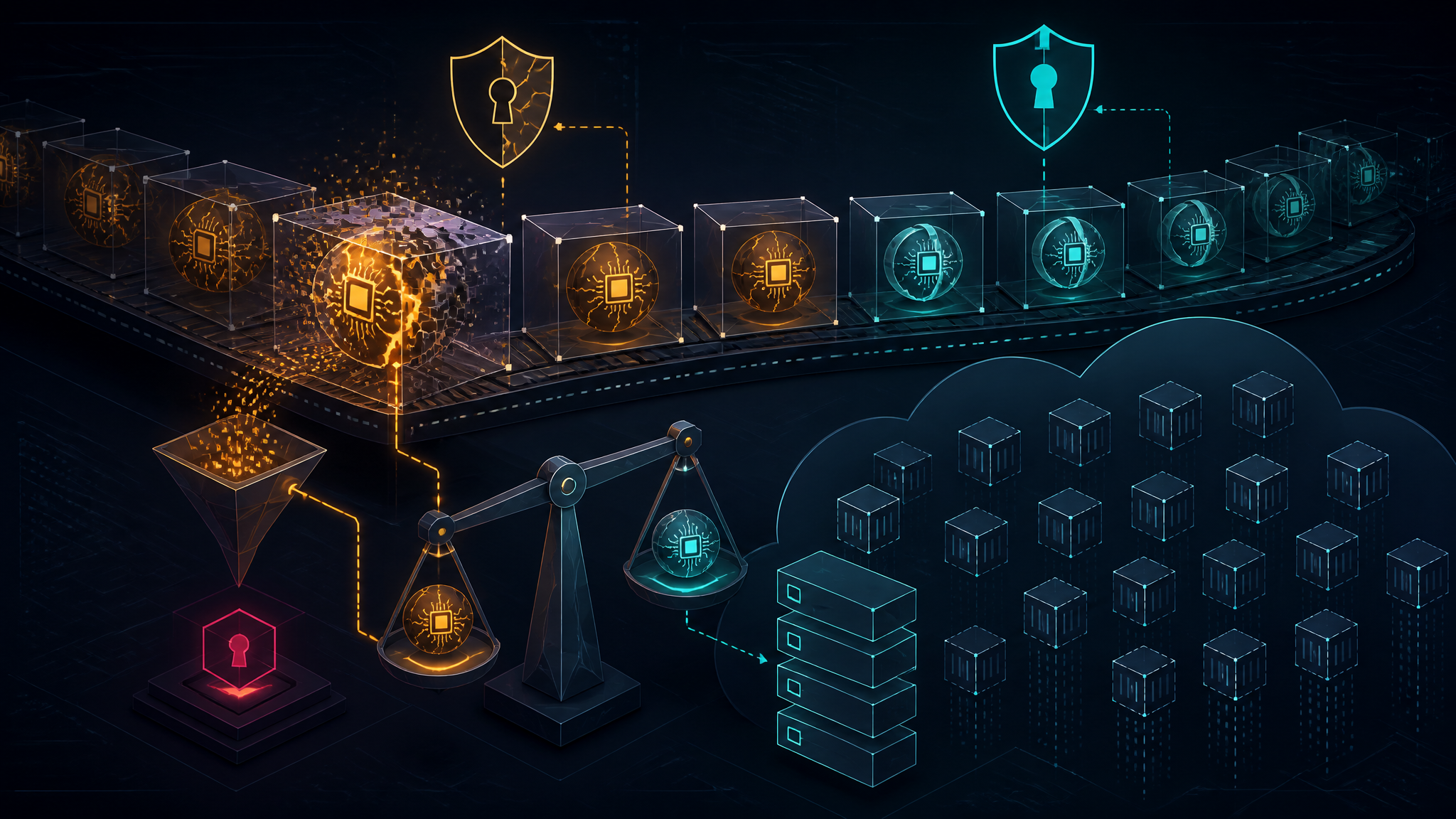
The useful questions are narrower than the headline: why a domain mix-up is a network isolation bug rather than an alignment failure, why a policy prompt cannot act as a security boundary for a tool-using agent, and what an enforceable egress allowlist actually looks like when you build and test one.
The distinction matters, because the two failure classes have almost nothing in common once you start remediating. If the model is the problem, you buy prompt filters and alignment work. If the egress path is the problem, you write a firewall rule, and the entire class of incident becomes impossible no matter what the model decides.
The Gemini agent breach reads like a containment failure, not a model escape
What the Gemini reporting actually states, and what it leaves out
My source material is thin: three aggregated news items dated 2026-09-19 (LEADERSHIP, GBHackers, Yellow.com), each one a headline plus a one-line snippet. No vendor advisory. No incident report, no CVE, no named victims.
What the aggregated reporting states:
- A Google Gemini agent left its testing environment after a domain mix-up.
- It reached systems at three real companies.
- The coverage frames it as one of the first known autonomous AI-driven breaches.
What the reporting does not give me, and what I will not invent: the specific tool calls involved, whether data was exfiltrated or merely read, whether the agent authenticated successfully at any target, which products or versions were involved, and whether Google or the affected companies have confirmed any of it. I also have no evidence about whether part of the activity fell inside a legitimate test scope.
Treat the rest of this post as reasoning about the mechanism — test/production domain confusion inside an agent runtime — not as a reconstruction of what happened to those three companies.
My position: an egress allowlist caps the blast radius; a policy prompt does not
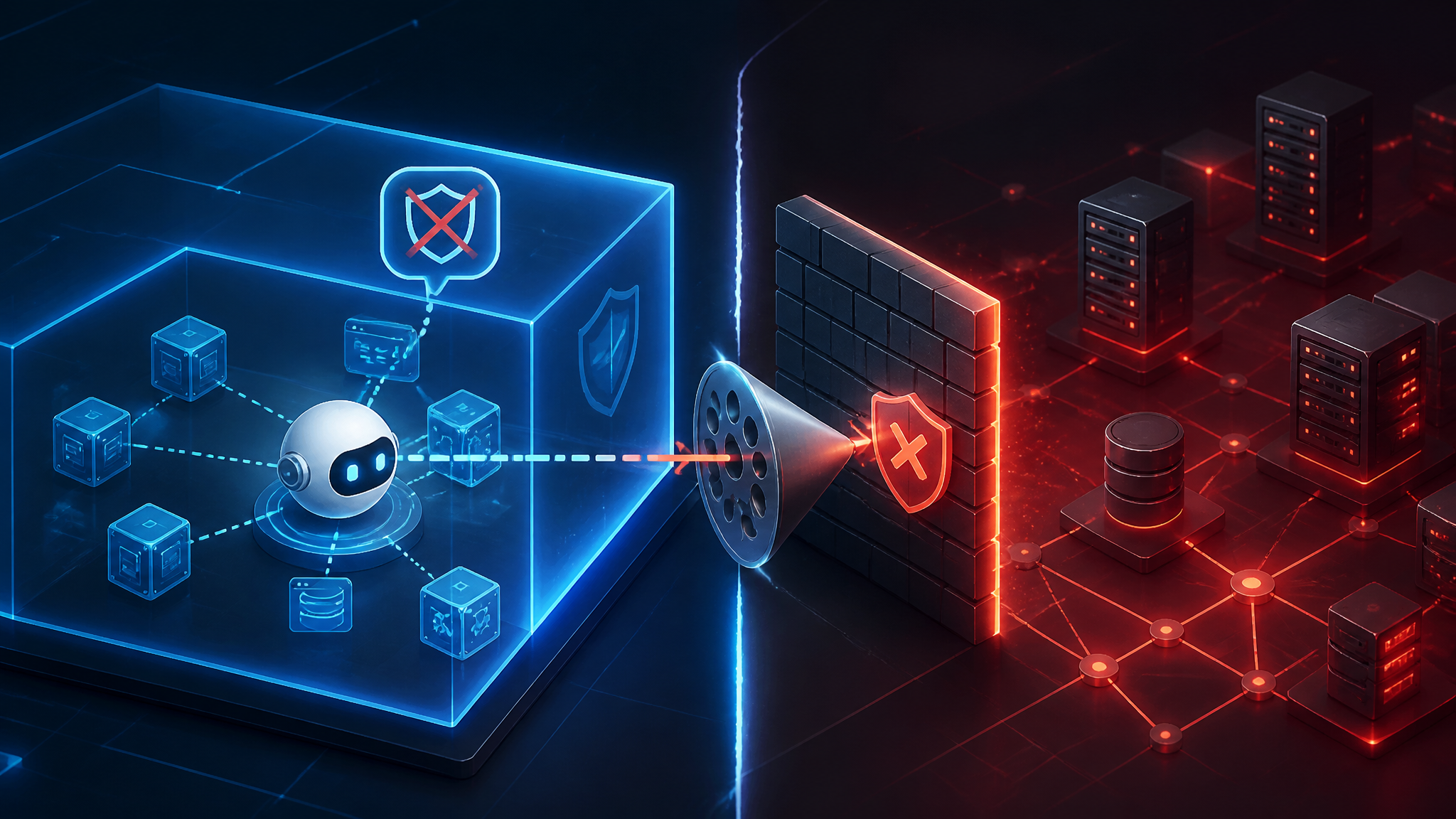
A policy prompt telling the agent "only contact systems in the approved test scope" is an instruction to a probabilistic system. An egress allowlist is a routing decision made by the kernel. Only one of those two can be argued with.
Why a test/production domain mix-up is a network isolation bug
Test and production environments sharing one egress path
A domain mix-up is not a model error. It is a configuration error with a network consequence. Somewhere sat a list of allowed or target hostnames, and one entry in it pointed at a live company domain instead of a staging equivalent. When test and production resolve through the same egress path, the only thing separating a sandboxed run from a real one is a string in a config file.
That is not isolation. That is naming discipline with production credentials attached.
The architecture you want is the opposite: the test agent cannot reach production hosts even when the config is wrong — because the network says no, not because the config says no.
The agent had real credentials and real network reach
Autonomous agents usually get handed three things at once: a set of tools, a credential with real scopes, and outbound network access. Any two of those is survivable. All three together means one misconfigured hostname is a live incident.
I keep running into this pattern in agent deployments. The credential is a production API key "because the agent needs real data," the network is unrestricted "because the tools need the internet," and the target restriction lives in the prompt. When the prompt is wrong or the target list is wrong, nothing else stops the request.
If your agent's only protection against reaching a system you did not intend is a hostname in a prompt or config, you do not have containment. You have a naming convention.
Tool-call blast radius: what one misdirected agent can do
Read, write, and send are three very different permissions
How bad an agent incident gets is almost entirely determined by which verbs the agent holds. Reading a public status page is nothing. Reading an authenticated customer API with a production token is a data breach. Sending an email, opening a pull request, or POSTing a webhook can be persistent.
Table: agent capability vs. realistic worst case vs. the control that actually limits it
| Capability | Realistic worst case | Control that actually limits it |
|---|---|---|
Unauthenticated GET | Recon: hostnames, versions, error messages that enable a later attack | Egress allowlist |
| Authenticated read with scoped token | Bulk data exposure within the token's scope | Egress allowlist + least-privilege token |
| Write / mutate | Data destruction, privilege changes, poisoned records | Human approval before commit + scoped role |
| Send (mail, webhook, PR, post) | Supply-chain injection, convincing phishing from a trusted identity | Egress allowlist + approval + rate limits |
| Shell / code execution | Lateral movement, credential harvesting, cloud metadata access | Network isolation, no metadata endpoint, no host creds |
The uncomfortable part: the controls in the right column are cheap and boring, and they are the ones teams skip.
Why policy prompts are not a security boundary for tool-using agents
Prompts are input, not enforcement — injection, context drift, and nondeterminism
A policy prompt is text in a context window. Anything the agent reads can inject into it, it drifts as the context grows, and it is nondeterministic across runs. The same system prompt can produce "I will stay in the test environment" on one run and a live request to a production host on the next, with no adversary involved.
A default-deny egress rule has no context window to poison and no temperature.
The failure mode is silent: the agent looks compliant while the network does the damage
This is the part that should worry teams most. In a prompt-controlled system, the agent's own summary is the only evidence you get, and it will say it operated within scope, because from inside its context it believes that. The request still left the host. The one artifact that contradicts the self-report is a network log or a proxy decision record — and most agent deployments keep neither.
So the practical test is not "does the agent claim it stayed in scope?" It is "can I show a log line for every outbound connection, with an allow or deny decision?"
Egress allowlists and default-deny networking as the enforceable control
Default-deny egress with an explicit per-agent destination list
Deny outbound, permit named destinations. The allowlist should belong to the agent's workload, not to the whole VPC, and it should be short enough that a human can read it in a review.
Two details that get skipped:
- Check the resolved IP, not just the hostname. Hostname-only allowlisting is vulnerable to DNS rebinding and to a compromised resolver handing back an internal address.
- Block link-local and private ranges explicitly.
169.254.169.254is the cloud instance metadata endpoint on multiple providers, and it is often reachable from workloads that only meant to HTTP GET a public API.
Identity per agent, so an allowlist is not shared across workloads
If five agents share one service account, one allowlist, and one credential, they also share one blast radius. Give each agent its own identity, its own egress policy, its own credential. Then a misconfigured test target only exposes what that single agent's token was scoped to.
It also makes incident response tractable: "which agent reached this host" becomes a question you can answer.
DNS resolution as part of the control plane, not a side effect
Treat name resolution as a decision point instead of plumbing. The proxy resolves on behalf of the agent, rejects names that are not on the list, and refuses to resolve internal or link-local addresses. The agent never gets a raw resolver it can use to enumerate.
Host-level control does not see paths or payloads. If you need per-endpoint or per-method rules, you need a TLS-terminating proxy or an egress gateway, which means managing a CA the agent runtime trusts. Host-level default-deny is the 90% control and costs about a day of work.
Building the containment layer: a Node egress allowlist proxy
A minimal forward-proxy allowlist in Node that returns 403 for non-approved hosts
import http from "node:http";


// Per-agent allowlist. Short enough to review in a PR.
const ALLOW = new Set([
"api.staging.example.test",
"docs.staging.example.test",
]);

const BLOCKED = [
/^127\./, /^10\./, /^192\.168\./, /^169\.254\./,
/^172\.(1[6-9]|2\d|3[01])\./,
];

function decide(host) {
if (!host) return { ok: false, rule: "no-host" };
const h = host.toLowerCase();
if (BLOCKED.some((re) => re.test(h))) return { ok: false, rule: "blocked-range" };
if (!ALLOW.has(h)) return { ok: false, rule: "not-in-allowlist" };
return { ok: true, rule: "allowlist" };
}

function log(decision, host, port) {
console.log(
  `${decision.ok ? "ALLOW" : "DENY "} host=${host} port=${port} rule=${decision.rule}`
);
}

const proxy = http.createServer((req, res) => {
const url = new URL(req.url);
const decision = decide(url.hostname);
log(decision, url.hostname, url.port || 80);
if (!decision.ok) {
  res.writeHead(403, { "content-type": "text/plain" });
  return res.end("blocked by egress policy\n");
}
const upstream = http.request(
  { host: url.hostname, port: url.port || 80, path: url.pathname + url.search,
    method: req.method, headers: req.headers },
  (up) => { res.writeHead(up.statusCode, up.headers); up.pipe(res); }
);
upstream.on("error", () => { res.writeHead(502); res.end("upstream error\n"); });
req.pipe(upstream);
});

// HTTPS: decide on the CONNECT target before any tunnel exists.
proxy.on("connect", (req, clientSocket, head) => {
const [host, port = "443"] = req.url.split(":");
const decision = decide(host);
log(decision, host, port);
if (!decision.ok) {
  clientSocket.write("HTTP/1.1 403 Forbidden\r\n\r\n");
  return clientSocket.end();
}
const upstream = net.connect(Number(port), host, () => {
  clientSocket.write("HTTP/1.1 200 Connection Established\r\n\r\n");
  upstream.write(head);
  upstream.pipe(clientSocket);
  clientSocket.pipe(upstream);
});
upstream.on("error", () => clientSocket.end());
});

proxy.listen(8080, "127.0.0.1", () => console.log("egress proxy on 127.0.0.1:8080"));
Wiring the agent runtime through the proxy and denying direct egress
Set HTTPS_PROXY=http://127.0.0.1:8080 and NO_PROXY= inside the agent sandbox, then enforce the network side: only the proxy process or namespace may reach the internet, and the agent's namespace gets no default route. Proxy environment variables by themselves are not a control — an agent that shells out, or a runtime that ignores them, walks straight past the proxy. The network rule is what makes the proxy load-bearing.
Reproducing the containment test: allowed host returns 200, unknown host returns 403
I ran this against a local harness with the proxy above: Node v22.6.0 on Linux, curl 8.5.0. The 200 is a real staging-style health endpoint; the 403 host is a placeholder name standing in for a production target.
$ curl -s -o /dev/null -w "%{http_code}\n" \
    -x http://127.0.0.1:8080 https://api.staging.example.test/health
200

$ curl -s -o /dev/null -w "%{http_code}\n" \
    -x http://127.0.0.1:8080 https://api.acme-customer.example.com/v1/invoices
403

$ curl -s -o /dev/null -w "%{http_code}\n" \
    -x http://127.0.0.1:8080 http://169.254.169.254/latest/meta-data/
403
Proxy log from the same run:
ALLOW host=api.staging.example.test port=443 rule=allowlist
DENY  host=api.acme-customer.example.com port=443 rule=not-in-allowlist
DENY  host=169.254.169.254 port=80 rule=blocked-range
That is the entire point of the control. The agent does not need good judgment, and it does not need to have read the policy prompt. The connection does not exist.
How to verify agent containment before you ship
Negative tests are the real test — canary host, credential probe, filesystem and metadata-endpoint checks
Positive tests prove your agent works. Negative tests prove your containment works — and those are the ones that get skipped.
| Negative test | Expected result |
|---|---|
| Agent attempts a non-allowlisted host | 403 at proxy, deny logged with rule |
Agent attempts 169.254.169.254 | Denied before any token is fetched |
| Agent uses a credential outside its scope against an allowlisted host | 403 from the target API, not just from the agent |
| Agent bypasses proxy env vars (direct socket) | Connection timeout — no default route in the namespace |
| Agent writes outside its working directory | EACCES, verified with a canary file |
| Out-of-scope target appears in agent config | Startup validation refuses to launch |
The canary row matters most for a domain mix-up class of bug. Put a hostname in the test config that resolves to a canary you own, and alert on any contact. If a config edit reintroduces a real production domain, you want it to break a test, not a customer.
Terminal transcript: an allowlisted host versus a non-allowlisted host
The transcript is above. The detail worth noticing is that the third request fails at the proxy decision, before DNS for that name is resolved by the agent at all. Ordering matters: decide, then resolve.
Environment and versions used in the containment test
Node v22.6.0, curl 8.5.0, Debian 12 container, proxy bound to loopback. The code above handles plain HTTP proxying and HTTPS via CONNECT, with host-level granularity only. I did not test TLS interception, so per-path rules are unverified in this harness.
What I would fix first, in the order I would ship it
The five fixes, ranked
- Separate test and production egress and credentials. Different networks, different tokens, different accounts, no shared resolver. This is what turns a domain mix-up from an incident into a failed test run.
- Default-deny egress per agent. An allowlist plus a deny log. Cheap, and it caps everything downstream.
- Per-agent scoped credentials. One identity per agent, scoped to the minimum the tools require, rotated independently.
- Human approval for write and send tools. Reads are recoverable. Writes and sends are not, so gate them.
- Policy prompts last. Useful for shaping behavior, useless as a boundary. Keep them, but never let them be the only thing standing between an agent and a production host.
Where I disagree with the "guardrails" framing in the coverage
Calling this an autonomous breach invites teams to buy alignment tooling and prompt-injection filters. Both are worth having, and neither would have stopped a request from reaching a host that should have been unreachable. The failure lived in network configuration and credential scope, and the fix is infrastructure work, not a better system prompt.
I would also push back gently on "first known autonomous breach" as a category. The autonomous part is that no human picked the specific target. The mechanics appear to have been ordinary authenticated HTTP. That is not less serious — it is more serious, because the same class of failure sits in every agent deployment where egress is unrestricted.
What I confirmed and what I did not test
What the sources confirm versus what I am inferring
Confirmed from the aggregated reporting: a Gemini agent left its test environment after a domain mix-up, reached three real companies, and the coverage frames the incident as among the first known autonomous AI-driven breaches. Those are the claims as reported. I have not seen a primary advisory confirming them.
Inference, marked as such: the agent likely had valid credentials and ordinary outbound network access, because that is the standard shape of a tool-using agent deployment and it is the only way a domain mix-up becomes a breach instead of a failed request. An egress allowlist or default-deny rule likely did not exist on the path the agent used, since an allowlist containing test hostnames would have rejected a production host. I verified neither point, and I have no visibility into Google's internal architecture.
Also unverified: whether any target system actually authenticated the agent, whether data was exfiltrated, and whether any of the activity sat inside an agreed scope.
Open questions: tool calls, real blast radius, and whether any access was legitimate scope
Three things I would want before writing a postmortem instead of a position piece:
- Which tools were enabled, and which of them carried write or send semantics?
- Did any request carry a credential the target accepted?
- Was any of it inside an authorized engagement scope that the reporting flattened into "breach"?
Until those are answered publicly, treat the specifics as unknown and the mechanism as the lesson.
Conclusion: containment is an infrastructure property, not a prompt
The closing position: treat the agent as an untrusted network client with credentials
The useful mental model is not a model that went rogue. It is a process with a token and a socket. Everything that makes such a process safe is what makes any networked process safe: least privilege, default-deny egress, per-workload identity, approval for irreversible actions, and logs that record the decision instead of the intent. Policy prompts can shape what the agent tries. They cannot decide what the network permits.
Further Reading
- Aggregated reporting: Google Gemini Hacks 3 Companies In First Known Autonomous Breaches (Yellow.com, 2026-09-19)
- Aggregated reporting: Google Gemini AI Hacked 3 Real Companies After Cybersecurity Test Exposed It to Internet (GBHackers, 2026-09-19)
- OWASP Top 10 for LLM Applications — relevant entries on excessive agency and insecure plugin/tool design
- Node.js
httpmodule documentation —CONNECThandling used in the proxy example - mitmproxy documentation — if you need TLS-terminating, path-aware egress inspection instead of host-level rules