Shrinking the Vulnerability Window: Lessons from Apple’s AI-Driven Patching Pipeline
A report circulating through Google News says Apple is changing how it handles security updates in response to AI-shaped threats. The headline is not the interesting part. The real question is operational: can a vendor shrink the gap between “we know there is a problem” and “most devices are actually protected” fast enough to matter?
I am treating this as a patch-pipeline story, not a product-news story. If Apple is changing how it collects signals, ranks issues, and ships fixes, that affects real exposure time for every Mac, iPhone, and managed fleet near the edge of an update cycle.
What the report says, and what is actually confirmed
Apple is reported to be revamping its security update strategy in response to AI-shaped threats
The source material is thin. A public news snippet says Apple is adjusting security updates because attackers are using AI more aggressively. That direction sounds plausible, but in the material I reviewed it is still just a report.
What Apple’s own public materials do confirm is narrower:
- Apple publishes security releases and platform security guidance.
- Apple devices support automatic update behavior and managed deployment controls.
- Apple already has mechanisms for urgent fixes, including security-focused releases.
That is enough to talk about the engineering impact without pretending we know Apple’s internal design.
Separate the public claim from what Apple has not yet explained in detail
Here is the split I would keep visible:
| Category | Confirmed in the source material | Not confirmed |
|---|---|---|
| High-level claim | Apple is reportedly changing its security update strategy | Exact internal design |
| Motivation | AI-powered threats are the stated reason | Whether AI is used for triage, clustering, or release approval |
| Scope | Security updates are the focus | Which platforms, teams, or release channels are changing |
| Outcome | Not stated | Whether the update cycle is actually faster in practice |
That last line matters. “AI-driven patching” sounds like an improvement, but unless it reduces the time devices stay vulnerable, it is just a process label.
Why I am treating this as a patch-pipeline story, not just a product-news story
The real security boundary is not the date a fix exists. It is the time until a fix is installed on enough devices that abuse stops being cheap.
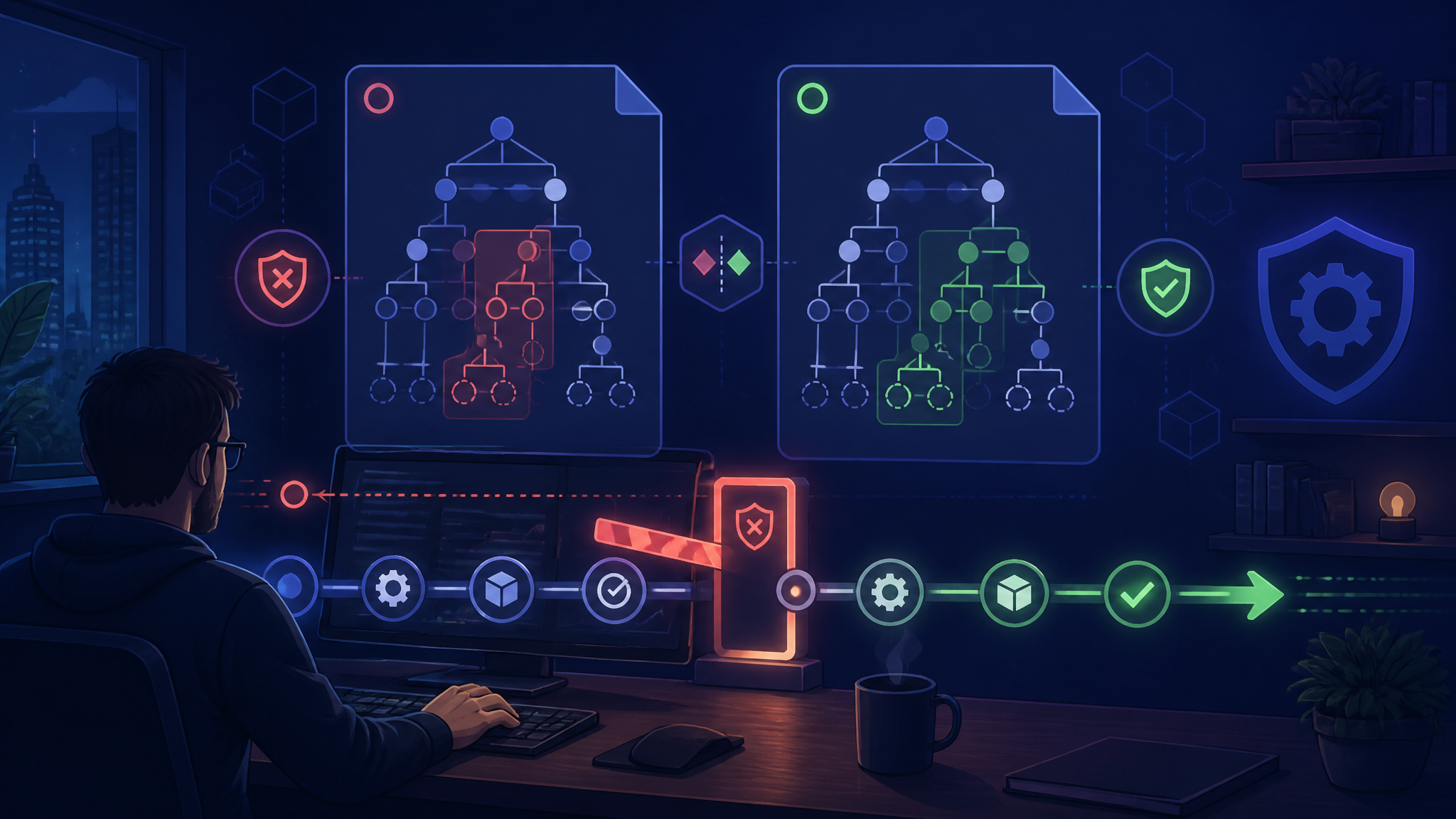
A patch pipeline has three jobs:
- Detect the issue.
- Decide to ship the fix.
- Get the fix onto endpoints.
AI can help with the first two. It does almost nothing for the third if users defer updates, MDM policies lag, or devices stay offline.
Why the vulnerability window matters more when attackers move faster
The useful metric is time from disclosure to practical exploitation, not just time to fix
Security teams often talk about “patch latency” as if it were one number. It is not.
A better breakdown is:
- time from first signal to internal decision,
- time from decision to release,
- time from release to real installation across the fleet.
A vendor can shorten the first two and still lose if the last one stays wide open. That is why exploitability and coverage matter more than raw patch count.
AI does not create every attack, but it lowers the cost of recon, variant generation, and targeting
I do not think AI magically invents new vulnerability classes. That would be the wrong story.
What it likely does is lower the cost of the boring parts of offensive work:
- rapid recon of exposed services,
- generating small exploit variants,
- summarizing advisories and diffing affected code paths,
- tailoring phishing or social engineering at scale.
That changes the defender’s problem. The attacker does not need to be more sophisticated at every step; they just need to be faster and more consistent.
The real risk is a short patch delay becoming a fleet-wide exposure window
A one-day delay on a consumer laptop is annoying. A one-day delay across thousands of managed Macs, contractor devices, and personal endpoints is a real exposure window.
If the attack path is remotely reachable or can be chained from a low-privilege foothold, the defender loses time twice:
- once while the fix is being prepared,
- again while devices are waiting for install and reboot.
That is why patch speed should be measured as a fleet property, not a vendor press-release property.
What an AI-assisted patching pipeline likely changes
Faster signal collection from crash reports, telemetry, fuzzing, and threat intelligence
If Apple is using AI here, the most plausible win is signal processing. Security teams drown in weak signals:
- crash clusters,
- duplicate bug reports,
- fuzzing noise,
- threat intel about active exploitation,
- user-visible regressions that are not security issues.
AI can help sort and summarize, especially when the volume is too high for humans to inspect manually first.
Triage that ranks issues by exploitability, reach, and user impact instead of raw bug count
The best use of AI in patching is not “find more bugs.” It is “rank the right bugs.”
A useful triage system scores issues by questions like:
- Can this be reached remotely?
- Does it require authentication?
- Is there public exploit chatter?
- How many devices are exposed?
- What is the likely blast radius if the fix breaks something?
That is a better release queue than “oldest report first” or “most duplicate reports first.”
Automated deduplication and clustering of similar reports before human review
This is where automation usually pays off first.
If 20 crashes are the same root cause, a pipeline that clusters them correctly saves human time. If 20 reports are actually 3 separate bugs, the pipeline must avoid collapsing them into one bucket. That is the hard part.
A good clustering step should reduce noise without hiding distinct risk.
Human approval still matters for regressions, false positives, and release gating
This is the part I would not automate away.
AI can rank, cluster, and summarize. It should not independently decide:
- whether a fix is safe to ship broadly,
- whether a regression risk is acceptable,
- whether a patch belongs in a point release or an emergency channel.
A patch pipeline that removes human approval is just a faster way to ship mistakes.
The mechanics that matter in practice
Detection-to-decision time: how quickly a security signal becomes a release candidate
This is the first bottleneck.
A good pipeline shortens the interval between “we believe this is exploitable” and “this is on the release train.” That requires:
- clean intake,
- deduplication,
- exploitation relevance scoring,
- escalation rules for active abuse.
Decision-to-delivery time: how fast fixes reach devices through staged rollout or emergency channels
Once a fix exists, distribution matters.
For Apple, that could mean:
- standard software updates,
- rapid response mechanisms,
- staged rollout to reduce regressions,
- emergency channels for urgent fixes.
If the delivery path is too conservative, you get a safer release process but a wider exposure window.
Coverage time: how long it takes until the patched version is actually installed across the fleet
This is the number most teams underestimate.
Coverage depends on:
- automatic updates,
- reboot behavior,
- network reachability,
- managed device policies,
- user willingness to accept prompts,
- offline time.
If 80 percent of devices update quickly and the remaining 20 percent drift for weeks, the fleet is still in trouble.
Why all three phases can fail independently
| Phase | What can go wrong | Security effect |
|---|---|---|
| Detection-to-decision | Noise, duplicate reports, poor prioritization | Fix arrives late |
| Decision-to-delivery | Release gating, regression fear, channel delays | Patch exists but is not shipped |
| Coverage | Deferred restarts, MDM friction, offline devices | Patch is shipped but not installed |
That is why “we fixed it” is not the same as “we reduced exposure.”
Where patch pipelines usually break under real pressure
Over-triage can bury the bugs that matter most
If every noisy report gets the same urgency, the pipeline becomes unreadable. Security teams start treating alerts as paperwork, and the real exploit path slips through.
Under-triage can delay high-risk issues until attackers have already moved
If the pipeline is too cautious, the result is just as bad in a different way. High-risk issues sit in queue while attackers weaponize them in the wild.
Regression fear can slow release cadence and widen exposure
This is a common failure mode in mature platforms. Teams get so nervous about breaking user workflows that they delay security fixes until they have “more confidence.” Meanwhile the attacker needs only one reliable path.
Update friction on managed devices, offline devices, and user-owned endpoints
This is the part defenders feel every week.
Even a good patch pipeline cannot force:
- a sleeping laptop to wake up,
- a contractor laptop to comply,
- a home device to leave a bad network,
- a user to reboot when asked.
The pipeline ends at release. The fleet ends much later.
What developers and security teams should do with this news
Treat OS patching as one control layer, not the primary trust boundary
Do not design your app as if the OS is always current. It will not be.
Use OS patching as a compensating control, not as the only thing standing between your app and compromise.
Verify that apps fail safely when the host OS is behind on security updates
If your app depends on secure host behavior, make that dependency explicit:
- block sensitive actions on obviously stale builds,
- degrade gracefully when required mitigations are missing,
- log version mismatches for security review.
You do not need to brick the app. You do need to avoid silently trusting an unpatched host.
Use MDM, compliance checks, and version reporting to measure real patch coverage
If you run a fleet, I would measure installed build numbers directly, not just “update available” status.
Useful checks on macOS include:
system_profiler SPSoftwareDataType
softwareupdate --history
For managed devices, also confirm enrollment state and policy drift:
profiles status -type enrollment
Example output might look like this:
Software:

    System Version: macOS 15.5
    Kernel Version: Darwin 24.5.0
profiles status -type enrollment
Enrolled via DEP: Yes
MDM enrollment: Yes
Those commands do not prove security posture by themselves, but they do give you a baseline for whether the fleet is actually where you think it is.
Prefer staged rollout plans that can absorb emergency security updates without drama
A mature release process should already know how to handle urgent updates:
- small pilot group first,
- fast expansion when no regression appears,
- separate path for security fixes,
- clear escalation when exploitation is active.
If your org treats every emergency update like a normal feature release, you are creating your own delay.
A practical checklist for Mac fleet hygiene
Confirm which devices receive automatic security updates and which do not
Check policy, not just assumptions. On Macs, that includes whether update automation is enabled and whether MDM overrides user choice.
Check whether reboot prompts are being deferred long enough to matter
A patch that requires a reboot but never gets one is not a patch in operational terms.
Audit managed configurations that disable or delay update behavior
Look for policies that accidentally create a long tail of exposed devices. Security teams often find that “temporary exceptions” became permanent drift.
Compare advertised update status with the actual installed build numbers
This is the simplest and most important control.
If the dashboard says “compliant” but the installed build number is old, the dashboard is lying.
My take: AI can shrink the patch window, but it does not solve the security problem by itself
Faster triage is valuable because it reduces exposure, but it should not be treated as a silver bullet
My view is simple: if Apple uses AI to accelerate issue ranking and release decisions, that is a real operational improvement. It should shorten the time between signal and fix.
But that is only part of the story. The hard part is still deployment at scale.
The strongest defense is still layered: patch quickly, isolate access, and reduce privilege
If you want the security benefit, pair faster patching with boring controls:
- least privilege,
- device compliance checks,
- segmented access,
- strong account recovery,
- automatic update enforcement where possible.
That is more effective than hoping the patch pipeline will save you after the fact.
If Apple really compresses the update cycle, that is a meaningful operational win for users and defenders
I would welcome it. Faster release engineering is one of the few vendor-side changes that can reduce real-world exposure without asking users to become security experts.
But I would still judge the result by fleet coverage, not press language.
Conclusion
The useful lesson is not that AI fixes security, but that patch latency is now a strategic risk
The report may or may not describe a fully AI-driven pipeline. What matters is the direction: vendors are under pressure to make security operations faster because attackers already benefit from automation.
A mature response combines faster release engineering with boring controls like inventory, enforcement, and least privilege
If you run a fleet, the right takeaway is not “wait for Apple to solve this.” It is to know your build inventory, enforce updates, and stop treating patching as a passive background task.