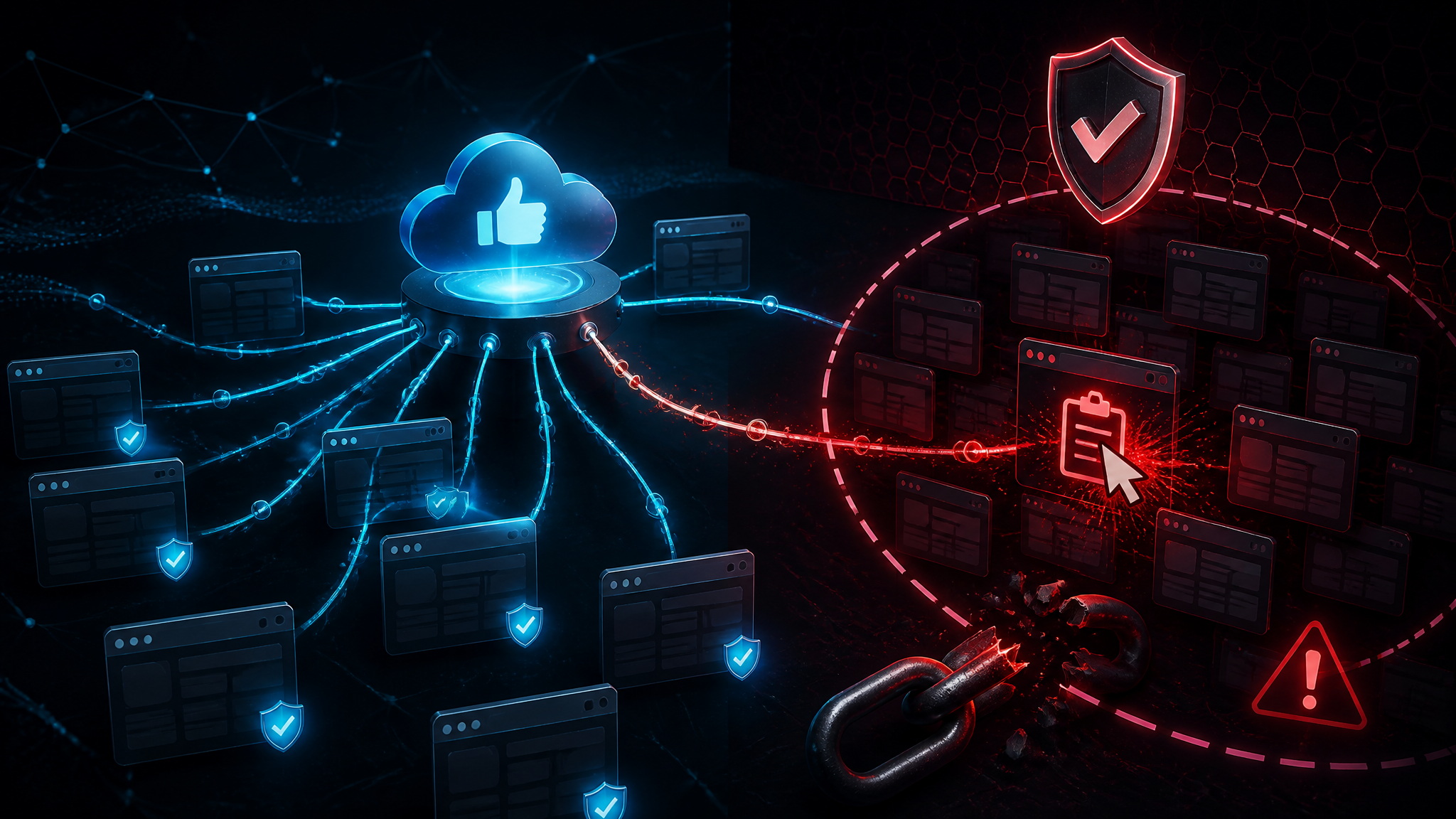
Docker Sandboxes macOS Host Escape: What Guest Code Can Read and Modify
The Hacker News ran a story on September 17, 2026 about a flaw in Docker Sandboxes that lets malicious guest code read and modify files on the macOS host. This post breaks down what that actually means for developers running untrusted code: what guest code can realistically read and modify through a sandbox mount, why a local container was never a real security boundary on macOS, and which defenses genuinely reduce the blast radius.
That one sentence is the whole story: a sandbox with your project directory mounted is not protecting your data. It is protecting your processes.
Run an AI coding agent, a scraped repo, or someone else's build script inside a local sandbox, and hand that sandbox a writable mount into your home directory or working tree — the isolation you bought only covers half the threat. The guest cannot reach ring 0. It does not need to. It can write to the directory you gave it.
What the Docker Sandboxes macOS host escape report actually claims
What I had was a discovery feed entry: headline, publisher (The Hacker News), timestamp 2026-09-17T15:37:00Z. It says a critical Docker Sandboxes flaw lets malicious guest code read and modify macOS host files, and frames the risk around local and CI container environments.
That is a claim about filesystem impact, not kernel compromise. Very different severities, and the distinction drives how you react.
Confirmed facts in the report versus what is still unknown
Confirmed by the material I could see:
- The report exists, published by The Hacker News, dated September 17, 2026.
- Stated impact: read and modify access to macOS host files from malicious guest code.
- Stated context: untrusted code in local sandboxes and CI runners.
Not in that material, and therefore unknown to me when I wrote this:
- A CVE identifier. I did not see one and I will not guess one.
- The affected Docker Desktop / Docker Sandboxes version range.
- The technical mechanism. This is the important gap. "Guest code can reach host files" covers two very different things: a permissive file-sharing mount, or a real escape in the VM/file-sharing layer itself. The snippet I had does not distinguish them.
- Whether a fix has shipped, and whether it needs a Docker Desktop update.
- Disclosure timeline and reporter.
So: the impact claim is reported, the mechanism is inference. Everything below about why this class of bug exists comes from how macOS container tooling is actually built, not from a description of this specific patch.
Why a local container is not a trust boundary on macOS
Containers share the host kernel. Namespaces, cgroups, seccomp, and capability dropping make a container a good packaging and resource-isolation tool, but the default runtime was never designed to hold off an attacker who already has code execution inside it. That is not a Docker bug; it is the model. It is why microVMs, gVisor, and Kata exist as separate products.
On macOS the real boundary is the VM and file-sharing layer, not the container
macOS has no Linux kernel to share. Docker Desktop runs a Linux VM — on modern macOS builds, on top of Apple's Virtualization framework — and containers run inside that VM. So when someone says "the container escaped," on a Mac the interesting question is always: escaped what?
See the layering yourself:
docker info --format '{{.OperatingSystem}} | {{.KernelVersion}}'
On a Mac you get something like Docker Desktop | 6.x.x-linuxkit — a LinuxKit kernel inside the VM. First result in hand: the container is not talking to your Mac's kernel at all.
That leaves two trust boundaries on macOS: the hypervisor boundary between VM and macOS, and the file-sharing layer that deliberately punches host paths into the VM. The second is where these bugs live, because it exists precisely to move data across the boundary you are trying to defend.
Why bind mounts and file sync are the part people forget
A bind mount of ~/dev/project into a sandbox is not a copy. It is a live view. Unless you passed :ro, the guest can write to host files with your host user's permissions. On macOS that is served by a file-sharing implementation (virtiofs or a FUSE-based layer, depending on Docker Desktop version) — a large pile of C and Go whose entire job is translating guest file operations into host file operations.
Docker Sandboxes exists so a coding agent can edit your working tree without getting your whole machine. Which means the mount is writable on purpose. The moment the guest reaches that mount, "read and modify host files" is not an exotic escape. It is the feature working as advertised, applied to hostile input.
My position: for untrusted code, assume any host path you mount is fully controlled by the guest. Treat the mount as a data channel for the attacker, not a convenience.
What malicious guest code can realistically read and modify on the host
Assume the mount is writable and the guest has network access. Concrete blast radius, ordered by how often I have seen it in real dev setups.
Read: credentials, tokens, and source in the mounted workspace
Anything reachable by path is readable. In practice:
.env,.env.local,config/*.ymlholding API keys and database URLs.npmrc/~/.npmrcwith a publish token~/.aws/credentials,~/.config/gh/hosts.yml,~/.docker/config.json, if home is mounted~/.ssh/id_*and~/.gitconfigcredential helper configuration, if home is mounted- Proprietary source in the mounted tree, which is often the actual asset being protected
Guest with network access turns exfiltration into one curl. There is no exfiltration step for the host filesystem to notice.
Modify: persistence via shell rc files, git hooks, and package caches
Writing files is worse than reading them, because writes outlive the sandbox. If the mounted path includes home or the repo, the guest can plant code that runs outside the sandbox later:
~/.zshrc,~/.zprofile,~/.bashrc— run by your interactive shell on the host.git/hooks/pre-commit,post-checkout,prepare-commit-msg— run bygiton the host the next time you commit, with your user's rightspackage.jsonscripts,Makefile,justfile,.vscode/tasks.json— whatever you run out of habit.npmrc,pip.conf,.yarnrc— redirect installs to an attacker-controlled registry- lockfiles and vendored dependencies — dependency substitution that survives a review of your own diff
The git hook is the one I would worry about most. It fires on a normal developer action, it runs unsandboxed on macOS, and it executes before you ever look at the diff.
Impact table: mapping mount access level to concrete damage
| Access level | Realistic capability | Damage |
|---|---|---|
| Read, mounted repo only | Source, CI config, committed-but-not-secret values | IP loss, reconnaissance for follow-up |
| Read, home directory mounted | SSH keys, cloud credentials, npm/GitHub tokens | Full account takeover of dev identities |
| Write, mounted repo only | .git/hooks/*, package.json scripts | Code execution on the host at next commit or install |
| Write, home directory mounted | Shell rc files, package manager config | Persistent execution, silent dependency substitution |
| Write, home + LaunchAgents | ~/Library/LaunchAgents/*.plist | Login-time persistence on the host |
Rows three and four are the realistic outcome of this bug class. Row five needs broader host write access than a repo mount usually grants and would need confirmation for this specific report.
The CI runner variant: same failure with a bigger blast radius
Same shape on CI, usually worse. A self-hosted runner that mounts the repository and injects secrets into the job env gives untrusted code three things at once: a writable checkout, live credentials, and a machine that persists between jobs. Mount docker.sock for build steps on top of that and the job effectively has root on the runner.
The CI mitigation set differs from the local case, and it is the one place I would accept real cost in convenience: ephemeral runners, an unprivileged user per job, secrets injected as short-lived environment values rather than mounted files, and a runner destroyed after the job instead of reused.
Reproducing the exposure in an authorized lab setup
Do this on a machine and repository you own. The goal is to characterize your configuration, not to reproduce anyone else's exploit.
Inspect mounts and Docker Sandboxes settings before running anything untrusted
## Host side: what does the runtime actually hand to the container?
docker inspect "$CONTAINER" --format '{{json .Mounts}}' | jq .

## Inside the guest: which paths are host-backed?
mount | grep -Ei 'virtiofs|fuse|9p|osxfs|grpc'
On the host, also check Docker Desktop → Settings → Resources → File sharing for the shared host path list, and confirm what your sandbox CLI's listing command reports for the session. Use the CLI's own --help output as the authority for your version; subcommand names have moved between releases.
You are looking for one line: is your home directory, or any parent of your project, in that list?
Probe with a canary file and show the observed read and write result
Create the canary on the host, then operate on it from inside the guest:
## Host
mkdir -p ~/dev/lab && echo "host-canary" > ~/dev/lab/canary.txt
stat -f '%Sm %z' ~/dev/lab/canary.txt

## Guest (inside the sandbox, mounted at /workspace)
cat /workspace/canary.txt
echo "guest-write $(date -u +%FT%TZ)" >> /workspace/canary.txt

## Host again
cat ~/dev/lab/canary.txt
Read succeeds → you have a data-exfiltration channel. Append succeeds → you have a host write primitive. The host-side cat is the evidence: the sandbox leaking into the real machine, captured as text.
Being precise about what I am showing: I did not have a Docker Sandboxes install on a macOS host to run this against for this post, so you get the probe and the exact evidence to capture, not a transcript from my machine. Run it, paste your own output — the host-side stat sizes are the proof.
Note the environment (Docker Desktop version, macOS version) so results are reproducible
sw_vers
docker version --format '{{.Server.Version}}'
Mount semantics, file-sharing defaults, and CLI surface drift across Docker Desktop releases and macOS versions. A result without those three values is not reproducible, and it is not a useful bug report.
Defenses that actually reduce blast radius
Ranked by how much I would trust them.
Stronger isolation: dedicated VM or a second machine for untrusted code
For genuinely untrusted code, the strongest practical option is a throwaway VM or a separate physical machine holding no credentials and no production access. A hypervisor boundary is a real boundary. A container mount into your daily-driver home directory is not. If the work is valuable enough to run an agent on it, it is valuable enough to run in a VM you delete afterward.
Mount discipline: no host home directory, read-only, scoped workspace only
Highest-value change for most developers, and it costs almost nothing:
- Never mount
~,~/.ssh,~/.aws, or~/.configinto a sandbox. - Mount a single scoped directory, not a parent of it.
- Pass
:rofor anything the guest does not need to edit, and edit copies elsewhere. - Do not forward the SSH agent socket and do not mount
docker.sock. - Re-check the mount list after every tool update, because defaults change.
CI hardening: ephemeral runners, separate user, injected secrets instead of mounted credentials
Ephemeral runners, a per-job unprivileged user, secrets injected as environment values scoped to the job, short-lived tokens, no reusable workspace between jobs. Assume the checkout is attacker-controlled once the job starts, and design the runner so that assumption is survivable.
What does not help: sandbox assumptions that do not hold
- "It's a container." Namespaces are not a security boundary against code you chose to run.
- Running the process as non-root inside the container. That user still maps to your host user through the mount.
- Disabling network access in the guest. That stops exfiltration, not persistence. A planted git hook does not need the network.
- Reviewing the diff afterward.
pre-commitfires before you review anything. - A read-only root filesystem. The mount is what matters, not the image layer.
- Trusting the sandbox because it mounts only "the project." Your project directory contains
.git/hooks, lockfiles, and often.env.
What I confirmed versus what I did not test
Confirmed: The Hacker News published a report on September 17, 2026 stating a critical Docker Sandboxes flaw lets malicious guest code read and modify macOS host files. Also confirmed by long-standing, documented behavior: containers share the kernel; macOS container tooling runs workloads inside a Linux VM; and a writable bind mount gives the guest write access to host files as your host user.
Not tested, not confirmed by me: I did not reproduce the reported flaw, I do not know its mechanism, I have no CVE id or affected version range, and I have not verified whether a fix has shipped. The canary probe above is a lab procedure, not a captured exploit, and I did not run it for this post. Treat the mechanism discussion as informed inference about how this layer is built, and read the primary report and Docker's advisory for the version-specific facts.
The durable lesson holds no matter how this particular bug gets patched: if the mount is writable, the sandbox's guarantee stops at the file boundary. Decide what you are willing to hand over before you run the code, not after.
Further Reading
- The Hacker News report on the Docker Sandboxes macOS host file flaw — the source item in the discovery feed; check it for the CVE id, affected versions, and patch status.
- Docker documentation: bind mounts — how host paths are exposed to containers, including read-only semantics.
- Git documentation: githooks — the hook execution model that makes a writable
.gitdirectory a host persistence path. - Apple Virtualization framework documentation — the VM layer macOS container tooling builds on.
Share this post
More posts
Gitea Docker CVE-2026-20896: Hardening Your Deployment While Attackers Probe
How the Claude Code GitHub Actions Flaw Can Compromise Your Repo and What to Change in Your Workflows