Dissecting the Packagist Attack: GitHub-Hosted Malware, Review Evasion, and Composer Pipeline Defense
What should make PHP teams uneasy is not only that Packagist packages were touched. It is that the malicious path could hide inside a very ordinary workflow: dependency metadata, package updates, and a GitHub-hosted Linux payload that looks like routine developer traffic.
When a package registry incident lands in the Composer ecosystem, the blast radius is bigger than a single app bug. The question stops being, “Is this library safe on its own?” and becomes, “Do I trust the entire chain from maintainer account to registry record to install-time behavior to runtime execution?”
Why this Packagist incident matters to Composer users
How the dependency trust model changes
Composer users already place a lot of trust before a line of application code runs. The package name, version constraint, dist or source URL, lockfile, and sometimes installer scripts all become part of the supply-chain decision.
This incident matters because it shows how a package can move through that chain in a way that looks normal until you inspect runtime behavior. A malicious update does not need a huge code rewrite. It only needs to slip past the weak points in the review process:
- the package metadata still resolves
- the version bump looks routine
- the diff is small or noisy
- the payload is fetched later from somewhere else
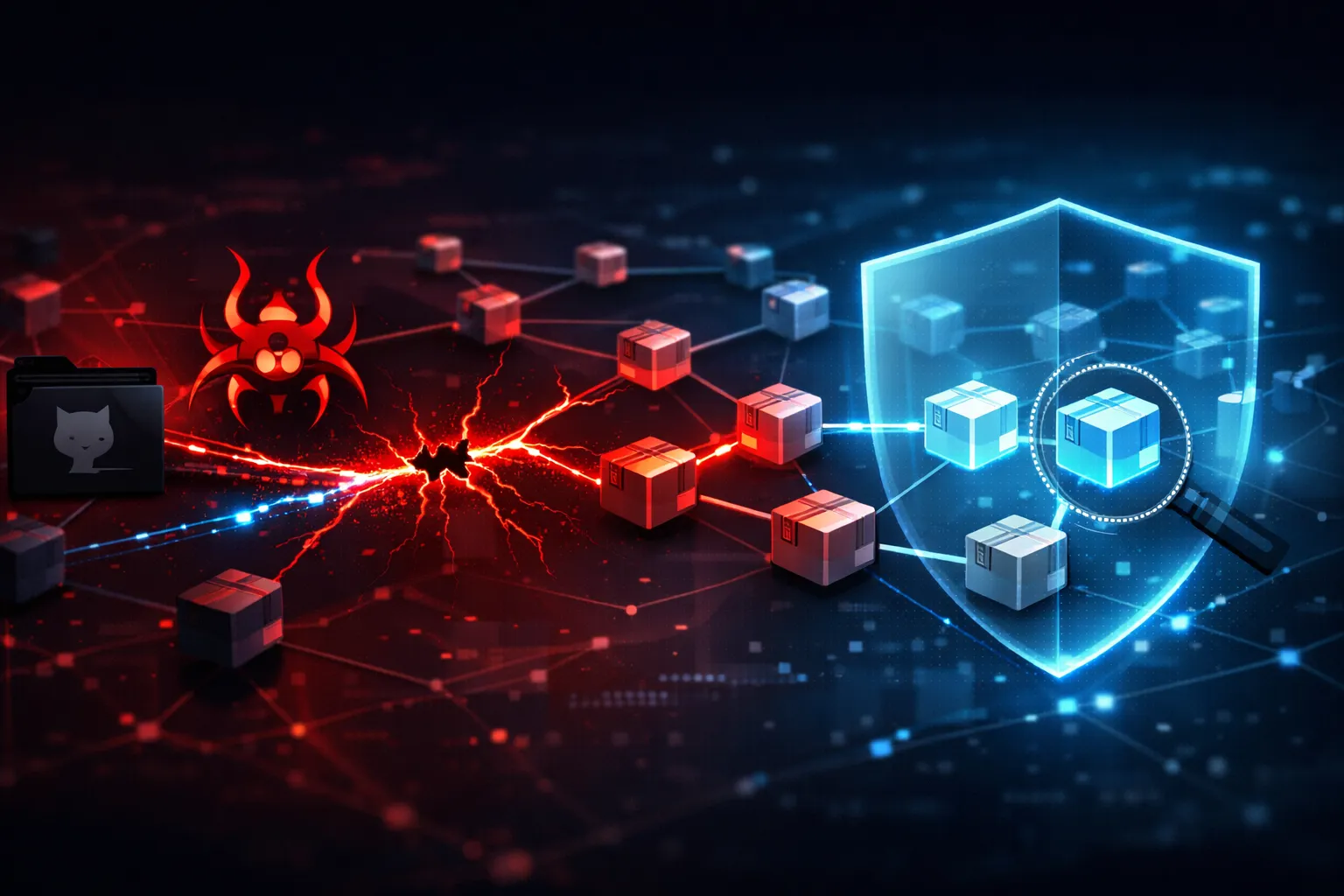
That last part is the interesting one. GitHub-hosted malware gives the attacker a second layer of indirection. The registry sees a package update. The reviewer sees a small diff. The real payload may arrive later over a channel many teams already treat as normal developer traffic.
Why a package registry compromise is different from a single vulnerable app
A vulnerable app usually hurts one application boundary. A compromised dependency registry can affect many repositories at once.
That changes the risk profile in three ways:
- Distribution speed: one package update can spread into many downstream builds.
- Trust amplification: maintainers and CI systems often accept registry packages by default.
- Forensics difficulty: the compromise may live in a transient install path, not a long-lived app branch.
If the malicious version lands in eight Composer packages, as the report says, that is already enough to create parallel exposure across different projects, environments, and deployment timelines. Some teams will never run composer update on purpose, but their lockfiles will still inherit the damage the next time the dependency graph is refreshed.
The attack chain at a high level
Initial package compromise and malicious update flow
The public reporting describes a supply-chain attack that infected eight Packagist packages and used GitHub-hosted Linux malware as part of the delivery chain. The exact maintainer compromise path may differ by package, but the overall flow is usually similar:
- attacker gains control of a maintainer account, release process, or source repo
- malicious package version is published or a tag is moved
- package metadata still points to a believable source
- malicious code either runs during install or downloads a second stage later
- downstream systems pull the update through normal Composer behavior
That flow is hard to stop if your controls only look at package name and version. The payload is not always inside the obvious diff. Sometimes the package is only the loader.
How GitHub-hosted Linux malware helped the payload look normal
Using GitHub as a host is effective because GitHub traffic is not suspicious by default in most environments. Developers fetch code from GitHub all day. CI systems clone from GitHub all day. Security tooling sees a trusted brand, a familiar domain, and often a flood of benign activity.
That does not make GitHub safe. It makes it a strong camouflage layer.
A malicious package can:
- download a second-stage binary or script from a GitHub repo or release asset
- fetch config, beacon URLs, or encrypted payload fragments
- use a normal-looking HTTPS request pattern that blends with build tooling
- avoid placing the full payload directly in the package diff
For a reviewer, that is much harder to catch than an obvious obfuscated blob embedded in PHP.
Why review systems missed the behavior change
Review systems are usually better at static comparison than behavior inference.
If a package diff adds a few lines that call out to curl, file_get_contents(), proc_open(), or a shell wrapper, that may be visible. But malicious maintainers know how to soften the signal:
- hide the action behind helper functions
- gate execution on OS, architecture, or environment variables
- trigger only in non-interactive install contexts
- delay fetches until after install
- keep the first-stage code tiny and boring
So the malicious change does not need to look dramatic. It only needs to survive a human skim and a few automated checks.
Packagist, Composer, and where trust is assumed
How Composer resolves package metadata and downloads code
Composer is not just a package downloader. It is a resolver, a source selector, a script runner, and a build-time orchestration tool.
A typical flow looks like this:
- Composer reads
composer.json - it resolves dependencies and versions
- it consults Packagist metadata and package source references
- it installs from a dist archive or source checkout
- it may run package scripts and autoload-related logic
- your app starts with the installed tree already modified
That means the trust boundary is broader than the PHP files in vendor/. The package can influence install scripts, plugin behavior, class autoloading, and even artifact contents if the build process copies generated files into the deployment bundle.
A better mental model is that dependency installation is code-execution-adjacent, even when no explicit shell command is present.
What Packagist can and cannot validate automatically
Packagist can verify that a package exists, that versions are published, and that metadata resolves correctly. It cannot, by itself, prove benign intent.
It generally cannot answer:
- whether the maintainer account was compromised
- whether the release automation was altered
- whether a package executes unsafe code during install
- whether a dependency downloads second-stage malware at runtime
- whether the package behavior changed in a way a static diff would miss
That is not a Packagist-specific flaw. It is the normal limit of any registry. A registry can distribute artifacts and validate metadata integrity. It cannot reliably reason about the semantics of the code it hosts.
The practical difference between version pinning and real trust
Version pinning is useful, but it is not a trust model by itself.
A lockfile gives you repeatability. It does not give you safety. If a malicious version is already in the lockfile, your build is now repeatable in the wrong direction.
The practical distinction is:
- version pinning says, “Use the same bytes I last approved.”
- real trust says, “I understand what those bytes do, how they are produced, and what they can reach.”
If your pipeline only checks that the version number matches, you have an artifact-consistency control, not a security control.
What the malicious packages were trying to do
Infection scope across eight Composer packages
The report says eight Composer packages were affected. Even without a complete public teardown of every package, that scope suggests the operation was broad enough to matter and small enough to avoid immediate attention.
Eight packages is useful for defenders because it points to a compromise pattern rather than a one-off mistake. Once multiple packages are involved, you should suspect one of these:
- shared maintainer credentials
- a poisoned release pipeline
- compromised upstream source repos
- coordinated malicious updates across related packages
That matters because the response changes. If one package is bad, you fix one package. If eight packages were touched, you need to assess maintainer identity, release provenance, and downstream build exposure.
Typical goals of dependency malware in PHP ecosystems
The final payload was not fully visible in the public summary, so I do not want to invent specifics. But dependency malware in PHP ecosystems usually aims for one or more of these:
- steal environment secrets from CI runners
- grab cloud credentials, API tokens, or SSH material
- alter build outputs or deployment artifacts
- establish persistence on developer machines or runners
- enumerate the host and dependency tree for later use
The reason this works so often is simple: build jobs are privileged. They have network access, repo access, secrets, and a direct path to artifacts.
What developers should infer even when the final payload is not fully visible
When you do not yet know the exact payload, treat the package as a loader and reason from capability, not intent.
Ask:
- Does it run during install?
- Can it fetch remote content?
- Can it execute shell commands?
- Does it inspect environment variables?
- Does it write outside the package directory?
- Does it alter the autoload path or generated files?
If the answer to any of those is yes, the package can already do damage even if the second-stage payload is unknown.
How GitHub hosting becomes a review-evasion layer
Why security tools treat GitHub traffic as low-friction
Many security controls classify GitHub as a developer destination rather than a risky external host. That is reasonable for normal work, but attackers benefit from that assumption.
A GitHub-hosted payload can blend in because:
- the domain is familiar
- HTTPS is expected
- the asset may look like normal source or release content
- network allowlists often already include GitHub for build tooling
- some EDR and proxy systems are tuned to tolerate GitHub noise
The result is not invisibility. It is lower friction.
External payload retrieval versus embedded malware
There is a big difference between a malicious PHP file sitting in a package and a package that calls out for an external payload.
Embedded malware is easier to inspect once you know where to look. External retrieval is more modular and harder to spot because the package can look inert until runtime.
That gives the attacker flexibility:
- swap payloads without republishing the package
- serve different content based on host or environment
- stage payloads in smaller chunks
- rotate infrastructure independently of package history
From a defender’s side, this means static package review is necessary but not sufficient. You also need runtime and network controls.
Tactics that blend in with normal developer infrastructure
The best supply-chain malware often copies patterns that already exist in your build process:
- downloading release assets
- checking architecture before execution
- using shell helpers like
curl,wget, orphp -r - storing files in temp directories
- cleaning up after execution
- failing quietly on non-target systems
Nothing about that behavior is automatically malicious. But in a Composer install context, any outbound fetch that is not clearly documented deserves scrutiny.
Walking through a safe verification workflow
Inspecting package diffs before upgrade
I usually start with package history, not the latest release.
Before upgrading, inspect:
- the release tag diff
- the changelog, if it exists
- the
composer.jsonchanges - any new scripts or installers
- any new network-facing code paths
A small review loop might look like this:
composer show vendor/package --all
git log --oneline --decorate --graph -- vendor/package
git diff old-tag..new-tag -- composer.json src/
If the package is pulled from Packagist and source is available, compare the current release against the previous known-good version. Focus on any new install hooks or helpers that were not there before.
Checking install scripts, post-install hooks, and autoload side effects
Composer gives packages several places to run code. That is legitimate, but it is also where attackers hide.
Check for:
scriptsentries incomposer.json- plugin classes
- post-install or post-update handlers
autoload.filesentries that execute on inclusion- dynamic code in bootstrap helpers
A quick review command can help:
jq '.scripts, .autoload, .autoload-dev, .extra' composer.json
Then inspect the actual PHP entry points and look for side effects in file scope. A file that performs network calls or shell execution as soon as it is loaded is a red flag.
Looking for network calls, command execution, and environment probing
The malicious package does not need advanced obfuscation to be dangerous. Simple capability checks are enough.
Search for:
curl,file_get_contents("httpproc_open,exec,shell_exec,passthru,systemfsockopen,stream_socket_client- environment probes like
getenv(),php_uname(),posix_* - temp file creation under
/tmpor platform equivalents
Example grep pass:
grep -RInE 'curl|file_get_contents|proc_open|shell_exec|exec\(|passthru|system\(|fsockopen|stream_socket_client|getenv\(|php_uname|posix_' vendor/ package-src/
Do not treat this as a malware detector. Treat it as a triage filter. The point is to find code paths worth reviewing manually.
Concrete detection checks for Composer pipelines
Lockfile review and unexpected transitive changes
The lockfile is where surprise often hides.
When reviewing composer.lock, look for:
- new packages you did not expect
- version jumps that cross major boundaries
- dist URLs or source references changing unexpectedly
- transitive dependency churn after a minor upgrade
- packages whose metadata changed but whose version constraint did not
Useful questions:
| Check | Why it matters |
|---|---|
| New package in lockfile | Could be a transitive dependency you never reviewed |
| Source URL changed | Could indicate a different origin or compromised release path |
| Dist hash changed unexpectedly | Could show repackaging or regenerated artifacts |
| Major transitive version bump | May bring new scripts or plugin behavior |
If a dependency update looks harmless but the lockfile balloons, inspect why before merging.
Repository scanning for suspicious maintainer or release activity
The package repo itself can tell you a lot.
Look for:
- sudden maintainer changes
- unusual release cadence
- tags created with no matching code review
- source repo issues or discussions mentioning compromise
- package descriptions or metadata edited abruptly
A compromised maintainer account often leaves soft clues before hard indicators appear. One release every few months followed by three rapid updates is worth a closer look.
CI checks for outbound connections during dependency install
This is one of the highest-value controls.
During dependency install, the build job should rarely need arbitrary outbound internet access beyond expected package sources. If it does, narrow it.
Practical options:
- block all egress except approved registries and mirrors
- log and alert on unexpected DNS or HTTP requests
- run installs in a network-restricted sandbox
- capture outbound destinations during
composer install
If you can, make the install step fail when it tries to reach a destination that is not on your allowlist. That turns a silent compromise into a visible break.
SBOM and package allowlist validation
A software bill of materials gives you a snapshot of what entered the build. It is not magic, but it helps.
Use SBOM checks to compare:
- expected package names
- expected versions
- package source provenance
- new transitive additions
An allowlist is even stricter. For high-risk environments, only approved packages or approved namespaces should be installable in CI.
That sounds rigid until you have to explain why a build runner reached out to a random GitHub asset and nobody noticed.
Defensive patterns that reduce blast radius
Prefer reviewed upgrades over blind composer update
The default composer update habit is convenient and risky.
A safer workflow is:
- update one package at a time
- inspect lockfile changes
- review source diffs
- run tests
- promote only after approval
This slows down dependency churn, but it also keeps malicious movement from hiding inside legitimate update noise.
Use dependency pinning, signatures, and internal mirrors where possible
Pinning alone is not enough, but it is still useful when paired with provenance controls.
Better patterns include:
- lock exact versions in production builds
- mirror dependencies into an internal repository
- verify package hashes where your tooling supports it
- restrict who can publish to internal mirrors
- prefer signed or provenance-backed artifacts where available
The mirror matters because it shortens the trust chain. Fewer live dependencies during the build means fewer chances for external tampering.
Separate build-time and runtime privileges
Most build jobs run with more access than they should.
Reduce risk by splitting:
- dependency install jobs
- compilation or asset build jobs
- deployment jobs
- runtime application containers
The install step should not hold long-lived cloud secrets. The build step should not have production database access. The runtime container should not inherit the entire CI credential set.
If the malicious package can only talk to a stripped-down runner, the damage shrinks.
Block unexpected network access during install jobs
This deserves repetition because it is one of the cleanest controls you can add.
If a package install needs to fetch from GitHub, ask why. If it needs arbitrary internet access, ask twice.
At minimum:
- log outbound destinations from the install phase
- alert on non-registry traffic
- deny shell-based downloaders in package hooks
- block unknown binaries and temp-file execution
A lot of dependency malware dies the moment it cannot reach its second stage.
What to do if you pulled a compromised version
Triage steps for a development machine or CI runner
If you suspect you installed one of the affected packages, start by containing it.
- stop active build jobs
- isolate the machine or runner from the network
- record the package versions from
composer.lock - identify when the install occurred
- inspect recent shell history, CI logs, and artifact outputs
- look for unexpected temp files, downloaded assets, or child processes
On a developer machine, also check browser sessions, SSH agents, cloud CLIs, and local secret stores. Dependency malware often tries to harvest whatever is already available in the environment.
Indicators to preserve for incident review
Do not wipe evidence before you collect it.
Preserve:
composer.jsonandcomposer.lock- CI job logs
- package cache contents
- proxy or firewall logs
- network connection logs
- file timestamps in build workspaces
- release artifacts produced after the suspicious install
These records help answer two important questions: what ran, and what left the environment.
Rotating secrets and checking downstream artifacts
Assume secrets on the affected runner may be exposed. Rotate:
- CI tokens
- package publishing credentials
- cloud access keys
- SSH keys
- API tokens stored in the environment
Then inspect downstream artifacts. If a malicious package altered build output, the compromised bytes may already have shipped. That includes containers, archives, frontend bundles, and generated PHP code.
A Composer-focused hardening checklist
Maintainer trust checks
- verify maintainer identity and release history
- watch for sudden tag or branch changes
- prefer packages with stable release processes
- review upstream repo ownership changes
- track packages maintained by single accounts carefully
Package diff review checks
- inspect
composer.jsonfor scripts and plugins - review autoloaded files for side effects
- search for network and shell execution
- compare source diffs across adjacent releases
- look for tiny diffs that add hidden loaders
CI and runner isolation checks
- run dependency installs in a sandbox
- restrict file system and network access
- separate build secrets from runtime secrets
- avoid long-lived credentials on install runners
- clear package caches after suspicious activity
Monitoring and alerting checks
- alert on outbound traffic during install
- log unexpected GitHub release asset downloads
- monitor for new PHP process trees spawned by Composer jobs
- alert on new packages in lockfiles
- review artifact hashes after dependency refreshes
Closing thoughts on dependency supply-chain defense
The main lesson for PHP teams
The main lesson here is not “never trust Packagist.” That is not a useful instruction. The useful instruction is: do not let registry trust stand in for behavioral trust.
If a Composer package can change your filesystem, reach the network, or execute code at install time, then your defense has to cover more than version numbers. You need review, network controls, privilege separation, and a habit of checking install-time behavior.
Why the safest pipeline assumes package metadata can lie
Metadata can lie. Version history can lie. A trusted-looking GitHub host can still deliver a malicious second stage.
So I like a simpler rule: assume package metadata tells you where to look, not what to believe.
That mindset catches more real incidents than any single scanner. It forces you to verify the install path, not just the published package. It also scales better when attackers split their payload between Packagist, GitHub, and the runtime environment.
For Composer users, that is the real defense: treat dependency installation like an execution boundary, not a download step.