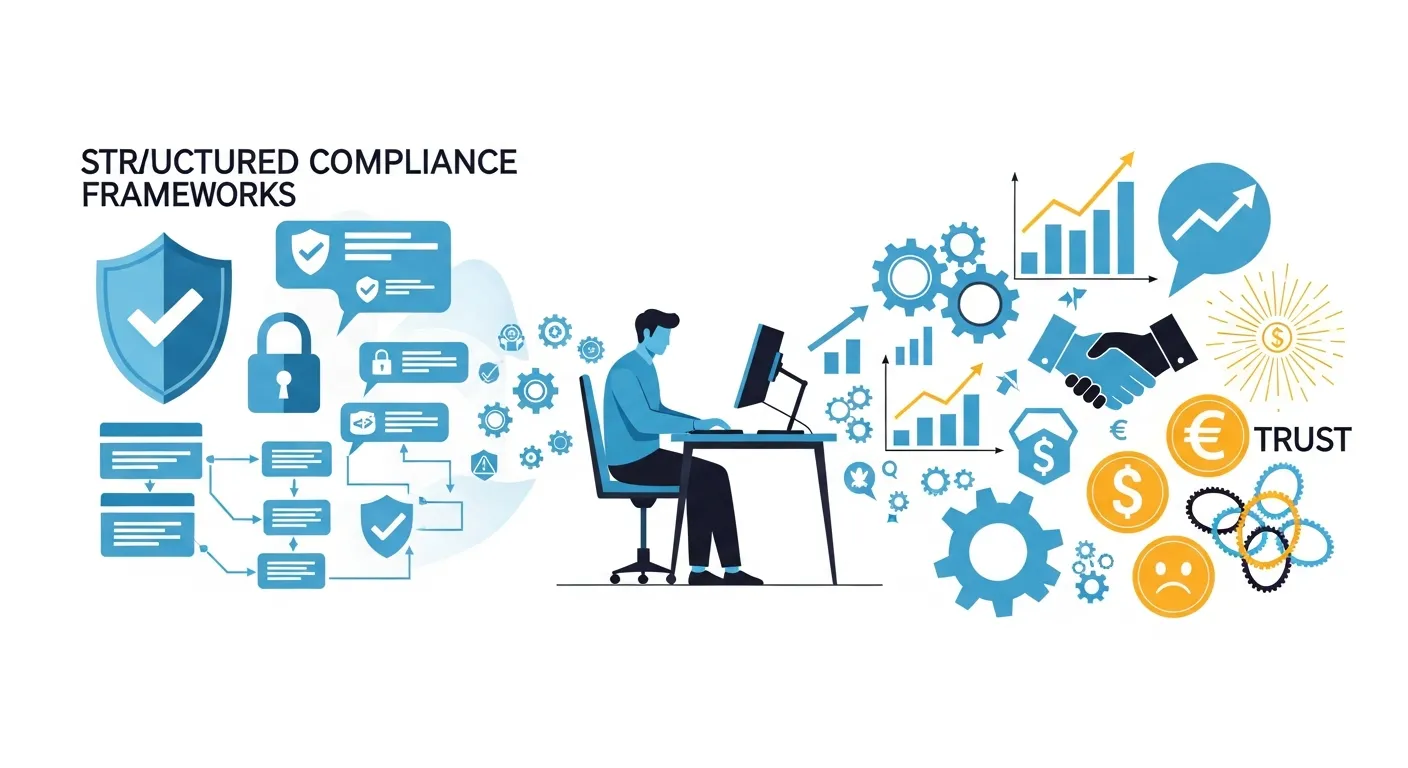
Turning Security Compliance from a Burden into a Revenue Stream
Compliance looks like pure cost when you first build it. You spend time on policies, logs, access reviews, and vendor paperwork before a single customer asks for it, so teams naturally treat it as overhead.
The mistake is stopping there. Good security controls change how fast you can close deals, how often buyers trust your answers, and how many enterprise prospects can even finish procurement. That is where the revenue shows up.
Why compliance feels expensive at first
Small teams usually feel compliance in the worst way: interrupted work. Someone needs an audit trail, so engineering pauses. Sales needs a security response, so the CTO writes one. A prospect asks about retention, access control, or incident response, and the same three people get pulled into a spreadsheet.
That feels like drag because the value is delayed. You pay the cost up front, while the benefit shows up later as fewer stalled deals.
The real trap is treating compliance as a document exercise. A folder full of policies does not make the business faster. Controls only matter when they reduce uncertainty for a buyer.
Where the actual revenue signal comes from
The revenue signal usually comes from two places:
- trust in the product and team
- lower procurement friction
If you sell B2B software, especially to larger customers, security is part of the buying process whether the product team likes it or not. The buyer is not rewarding you for having a policy. They are rewarding you for making their risk review easy to finish.
Trust as a sales filter
Security maturity often acts as a filter before the real evaluation even starts. If your answers are vague, inconsistent, or obviously assembled last minute, some buyers will just stop.
I have seen deals stall because a vendor could not explain who had production access, how secrets were stored, or whether logs were retained after account deletion. The product may have been fine. The business process was not.
Compliance as a procurement unlock
A lot of enterprise sales motion is blocked by simple control questions:
- Do you have MFA for admin access?
- Can you provide a recent penetration test summary?
- Do you have a vendor risk questionnaire response?
- Is there an incident response process?
- Can you prove access reviews happen regularly?
If the answer is yes and you can show evidence, you move forward. If the answer is “we do that manually,” procurement turns into a project.
The parts of compliance that buyers actually check
Evidence over policy language
Buyers rarely care about polished policy text by itself. They care about proof.
A useful internal rule is: if a control cannot be demonstrated, it is not ready for a security review. For example:
| Control area | Weak answer | Strong evidence |
|---|---|---|
| Access control | “Only the team can access prod.” | IAM group listing, audit log, approval record |
| Incident response | “We have a plan.” | Recent tabletop notes, escalation path, on-call rota |
| Backups | “Backups run nightly.” | Backup job logs and restore test result |
| Change management | “We review changes.” | Pull request history and deployment approvals |
The buyer is checking whether your story matches reality.
Repeatable controls over one-time audits
One-off compliance work looks good for a week and then decays. Repeatable controls survive staff turnover, product changes, and growth.
That means:
- access reviews run on a schedule
- secrets are managed through a standard system
- logs are retained with a defined policy
- new vendors go through review before use
- production changes leave an audit trail
A repeatable control creates a business asset. A one-time audit creates a presentation deck.
Turning controls into product and sales advantages
Faster enterprise onboarding
The cleanest revenue benefit is shorter onboarding. If a prospect asks for security proof and you already have it organized, the deal keeps moving.
I usually recommend keeping a small internal security packet:
- architecture summary
- access control overview
- incident response summary
- penetration test or assessment summary
- data retention and deletion notes
This is not marketing copy. It is a working set of evidence you can hand to a customer without rebuilding it every time.
Lower deal friction with security questionnaires
Questionnaires are where weak compliance gets expensive. A messy answer forces follow-up meetings. A consistent answer reduces back-and-forth.
The best teams answer from a maintained source of truth, not from memory. That source can be simple: a shared document plus links to logs, tickets, and control owners. The goal is consistency, not ceremony.
Better retention through fewer operational surprises
Compliance also helps after the sale. If your controls are real, you get fewer incidents that turn into churn, legal review, or emergency customer calls.
That matters because enterprise customers remember operational pain. If their security team had a rough first quarter with you, renewal conversations start colder.
What to measure so the business sees it
If leadership only sees compliance as cost, you are probably measuring the wrong thing.
Track business-facing metrics:
- time to complete a security questionnaire
- number of enterprise deals blocked on security review
- average days from verbal yes to signed contract
- number of repeat security requests answered from a standard packet
- incident count tied to missing controls
- time to produce evidence for a buyer
You want to show that controls reduce sales friction and support load, not just that audits were passed.
Common ways teams fake readiness
A lot of teams confuse paperwork with control. Common failure modes:
- policy documents exist, but no one follows them
- access reviews happen once, then stop
- production access is broad because “we trust the team”
- logs exist, but nobody can retrieve them during a review
- deletion promises are not backed by an operational process
- the sales team improvises answers that engineering cannot support
That kind of readiness usually breaks during a real customer review. It also tends to break during an incident, which is when the cost becomes visible.
Practical next steps for a small team
If you are small, do not try to solve everything at once. Start with controls that help both security and sales.
- Pick the 3-5 questions buyers ask most often.
- Write down the exact evidence you can show for each one.
- Standardize access to production and secrets.
- Make logging and retention understandable.
- Keep one current security packet for sales and procurement.
- Review the packet after every deal loss or security review.
The point is to reduce repeated work. If the same question hits the team five times a month, turn it into a maintained artifact.
Conclusion
Compliance becomes a revenue stream when it stops being a paper exercise and starts reducing buyer risk. The business does not pay for the logo on the certificate. It pays for faster trust, easier procurement, and fewer surprises after the contract is signed.
If you can prove the controls, keep them repeatable, and connect them to deal speed, compliance stops looking like a tax. It starts looking like sales infrastructure.