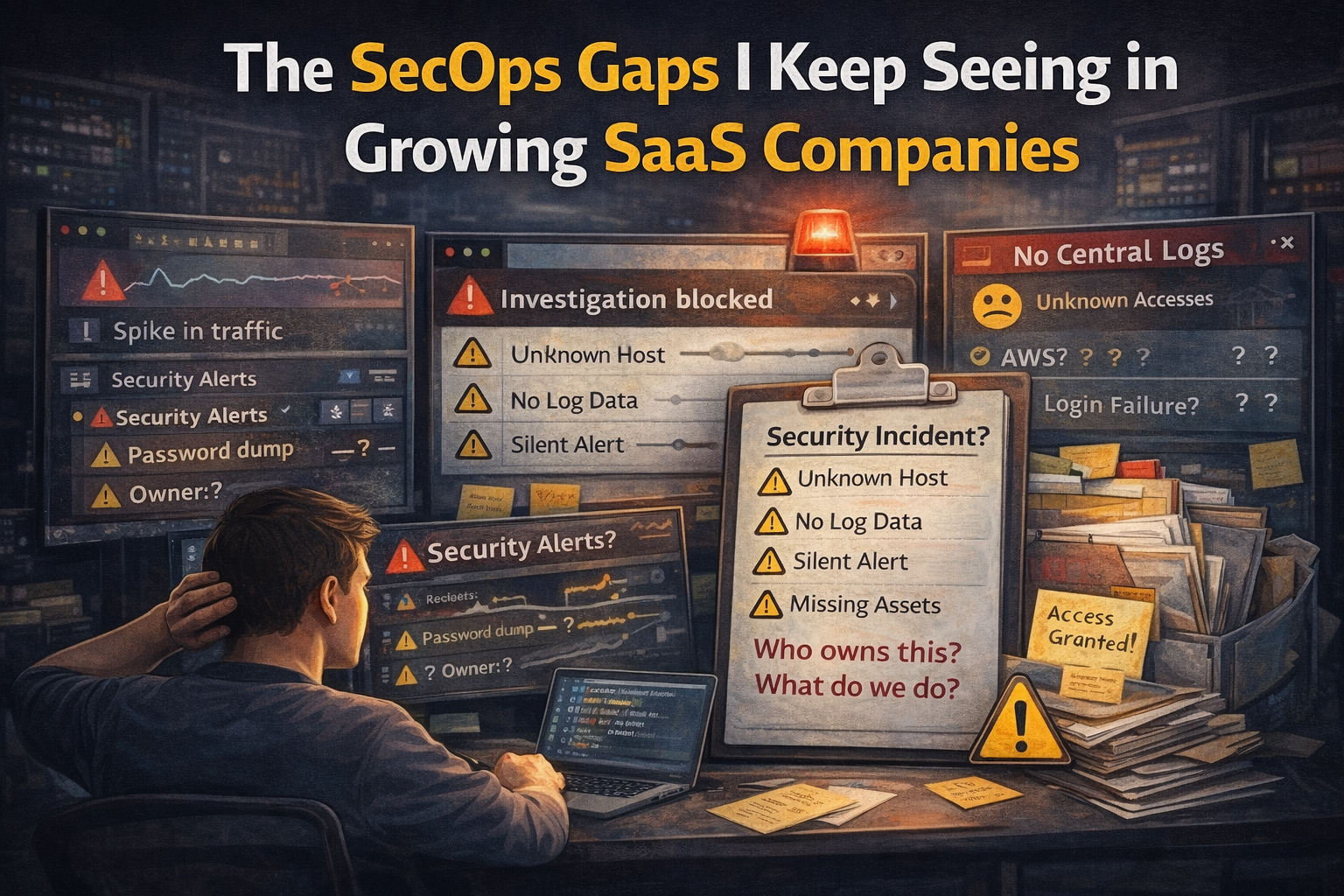
The SecOps Gaps I Keep Seeing in Growing SaaS Companies
A lot of SaaS companies do not ignore security operations on purpose.
They just grow faster than their internal visibility.
The product gets bigger. More services get deployed. More people get production access. More vendors get connected. More alerts get turned on. Then one day everyone realizes the company has logs, dashboards, and notifications everywhere, but nobody can answer the simple questions fast:
- what happened?
- who saw it first?
- which systems are affected?
- what is normal here?
- who owns the response?
That is usually where the SecOps gap becomes obvious.
Not because the company has zero tools. Usually it is the opposite.
They have enough tooling to create noise, but not enough process to turn that noise into detection and response.
Growth creates security drift. A setup that felt acceptable with one app and five engineers starts breaking when there are ten services, shared infrastructure, third-party integrations, and production changes every day.
The pattern I keep seeing
A growing SaaS company often looks fine from the outside.
The app is shipping. Customers are paying. Engineers are deploying. Metrics look healthy.
Then you look closer and the security operations side starts showing the same problems over and over:
- logs scattered across multiple systems
- alerts with no owner
- unclear escalation paths
- no reliable asset inventory
- weak environment separation
- too many people with too much access
- incidents handled in chat from memory
- no one reviewing the same class of failures after they happen
The issue is not that the company has no security effort.
The issue is that SecOps usually evolves reactively.
A vendor gets added, so another alert appears. A breach story hits the timeline, so MFA becomes mandatory. A weird production event happens, so someone saves a query in a dashboard. A customer asks for a security questionnaire, so policies get written quickly.
That is not nothing. But it is not a system either.
Gap 1: Logs exist, but nobody can actually investigate with them
This is probably the most common one.
The team says they have logs.
That sounds good until you try to answer a basic incident question and realize the logs are split across:
- app logs in one place
- reverse proxy logs somewhere else
- cloud audit events in a separate console
- database logs barely enabled
- auth provider events outside the main workflow
- container logs disappearing with restarts
- security-relevant events not normalized at all
This is where "we have logs" stops being useful.
Having logs is not the same as having an investigation path.
A good SecOps setup lets you follow a timeline across layers:
- incoming request
- auth decision
- application action
- database effect
- outbound call
- privilege change
- alert or anomaly
If those pieces live in six tools with six different retention rules and nobody knows the field names, investigation becomes guesswork.
Centralization matters, but consistency matters even more. A smaller set of usable logs beats a giant pile of fragmented telemetry no one can correlate.
Gap 2: Alerting exists, but triage does not
A lot of teams add alerting before they define what a response should look like.
So the result is predictable:
- too many alerts
- low-quality signals
- no threshold tuning
- no severity model
- no clear response owner
- alerts muted because they are annoying
- real incidents mixed with routine background noise
The mistake here is thinking alerts are the goal.
They are not.
An alert is only useful if someone can answer:
- is this real?
- how bad is it?
- who handles it?
- what gets checked next?
- when do we escalate?
Without that, the alert is just stress with a timestamp.
I keep seeing companies route everything into one shared channel and call that visibility.
That is not visibility. That is crowding.
Gap 3: Nobody owns the security response path end to end
This one gets dangerous fast.
In growing teams, ownership often fragments naturally:
- DevOps owns infra
- backend owns API behavior
- support sees customer weirdness first
- product hears about impact
- legal gets pulled in late
- leadership wants updates
- nobody is clearly running the incident
So when something real happens, the company starts with confusion instead of control.
The first 30 minutes matter a lot during an incident. If the response starts with:
- "Who is looking at this?"
- "Where are the logs?"
- "Was this expected?"
- "Who can revoke access?"
- "Who talks to the customer?"
then the company is already behind.
This does not mean every SaaS company needs a dedicated SOC.
It does mean someone needs explicit ownership for the response process, even if the team is small.
Gap 4: Asset inventory is weaker than people think
Ask a growing SaaS company to list all systems that matter during an incident and the answers are often incomplete.
You will usually get the obvious ones first:
- main app
- API
- database
- worker queue
- production server
- cloud provider
Then later the list keeps expanding:
- forgotten staging environments
- old VPS instances
- third-party cron services
- abandoned internal tools
- temporary debug endpoints
- analytics sinks
- support platforms
- CI runners
- webhook consumers
- admin panels
- legacy domains
This matters because you cannot monitor, harden, or respond around systems you do not track properly.
A lot of bad SecOps comes down to incomplete system awareness.
The incident does not start with malicious magic. It starts with a blind spot.
Gap 5: Access grows faster than access review
This is normal in fast-moving teams.
People need to ship, fix production, help support, inspect data, and unblock customers. So access expands over time.
The problem is that access almost never shrinks at the same speed.
That leads to:
- old credentials still active
- broad production access shared across roles
- engineers keeping admin permissions long after the need is gone
- third-party vendors holding more access than expected
- service accounts with unclear ownership
- secrets copied into too many places
The issue is not just least privilege as a concept.
The real issue is operational trust sprawl.
If too many people and systems can touch sensitive environments, then incident response gets harder too. You have more paths to inspect, more identities to verify, and more uncertainty during containment.
Gap 6: Detection is shallow because context is missing
A lot of alerts are technically correct and still operationally weak.
For example:
- login spike
- error spike
- large export
- privilege change
- token creation
- suspicious request rate
None of those mean much by themselves.
Good detection usually needs context like:
- which tenant?
- which role?
- which asset?
- which time window?
- which normal baseline?
- which source IP or environment?
- what changed right before this?
Without context, alerts are either too noisy or too generic.
This is why many growing teams end up relying on gut feeling instead of detection quality. Someone notices that "this feels weird" and starts digging manually.
That can work for a while. It does not scale well.
Gap 7: Incident response lives in people, not in playbooks
This is another common pattern.
The company has smart people who know how to deal with problems, but the response knowledge mostly lives in their heads.
That feels fine until:
- the right person is asleep
- the right person left the company
- the incident spans multiple teams
- stress makes people skip steps
- customer communication has to happen quickly
- evidence gets lost during improvisation
A basic playbook does not need to be fancy.
It just needs to reduce chaos.
For common scenarios like these, teams should already know the first moves:
- suspicious admin access
- credential leak
- production data exposure
- malicious OAuth or token activity
- compromised host or container
- mass customer-facing errors that might be security-related
Even a lightweight checklist beats improvising the same response every time.
Gap 8: The company watches production, but ignores internal security signals
Growing SaaS companies are often good at product health monitoring:
- latency
- uptime
- errors
- queue depth
- CPU
- memory
- deploy health
That is useful, but it is not the same as security monitoring.
Security-relevant signals often live in a different category:
- failed MFA patterns
- abnormal admin activity
- role changes
- token misuse
- export behavior
- audit log gaps
- unusual support-tool access
- repeated access denied events
- strange cross-tenant queries
- secrets usage outside normal systems
If the team only monitors for reliability, they may completely miss the early signs of abuse.
Gap 9: The same mistakes repeat because nobody closes the loop
A lot of teams do some version of incident review, but the review stops at the obvious surface layer.
The writeup says:
- root cause: misconfiguration
- impact: limited
- action item: improve monitoring
Then nothing substantial changes.
The better question is usually:
What made this issue easy to miss in the first place?
That answer is often more operational than technical.
Examples:
- no shared timeline during response
- logs missing key identity fields
- no owner for critical alerts
- too many exceptions in access rules
- weak handoff between support and engineering
- detection tuned for outages, not abuse
- investigation steps undocumented
- containment too manual
If those conditions stay the same, the incident class stays alive.
What better looks like
You do not need a huge security team to improve this.
You do need a smaller set of things done intentionally.
A healthier SecOps baseline for a growing SaaS company usually includes:
| Area | What good looks like |
|---|---|
| Logging | Centralized, searchable, enough retention, consistent fields |
| Alerting | Fewer alerts, better tuned, severity defined, owner assigned |
| Ownership | Named incident lead path, escalation flow, communication expectations |
| Access | Regular review, reduced standing privilege, clear service account ownership |
| Asset visibility | Current inventory of systems, services, vendors, environments |
| Detection | Alerts tied to meaningful risk, not just generic anomalies |
| Response | Lightweight playbooks for common scenarios |
| Review | Post-incident actions tracked to operational fixes |
None of that is glamorous.
That is exactly why it helps.
What I would fix first
If a growing SaaS company asked me where to start, I would not start by buying more tools.
I would start with four practical moves:
1. Pick one place to investigate from
Not every log source has to move immediately, but the investigation path needs a home.
When something happens, people should know where to start.
2. Cut alert volume and assign owners
Kill noisy alerts. Tune the useful ones. Define severity. Make ownership explicit.
An ignored alert is worse than a missing one because it creates false confidence.
3. Build a real asset and access review habit
Not once. Repeatedly.
What exists, who can touch it, and why that access still makes sense should not be mystery work during an incident.
4. Write the first playbooks before the next incident
Not giant policy documents.
Just practical first-response guides for the issues most likely to happen in your environment.
The goal is not enterprise theater. The goal is reducing the number of minutes wasted on confusion when something real happens.
Why this gets worse as the company grows
The dangerous part is that growth hides operational weakness for a while.
Revenue can grow while SecOps maturity stays flat.
That creates a gap between business confidence and security response reality.
Then one day the company has:
- more customers
- more data
- more environments
- more integrations
- more legal exposure
- more production complexity
but the incident handling model still looks like it did six months and three engineers ago.
That is usually when the pain shows up all at once.
Final thought
The SecOps gaps I keep seeing in growing SaaS companies are rarely caused by zero effort.
They come from partial effort that never turned into a system.
A few dashboards. Some alerts. A security questionnaire folder. A couple of good people who usually know what to do.
That can carry a company for a while.
But once scale shows up, vague ownership and scattered visibility stop being annoying and start becoming operational risk.
Good SecOps is not about looking advanced.
It is about making sure the company can detect, understand, and respond before confusion becomes part of the damage.