Testing Third-Party OAuth Trust: What the Vercel Incident Teaches About AI SaaS Integrations
What actually happened in the Vercel incident
Vercel said the April 2026 incident began with a compromise of a third-party AI tool used by a Vercel employee. That tool's Google Workspace OAuth app was taken over, which gave the attacker a route into the employee's personal Google Workspace account and then into the employee's Vercel account.
That matters because this was not a password spray or a direct flaw in Vercel's app. The entry point was trust: a connected SaaS tool with enough access to bridge identity, then internal systems.
Vercel's public update also said the attacker moved through systems to enumerate and decrypt non-sensitive environment variables. So the blast radius was not limited to account access. It reached secrets handling too.
Why a third-party OAuth grant became the starting point
OAuth grants are convenient right up until they become invisible infrastructure. A team approves a SaaS app once, then forgets it exists while the token keeps working.
In this case, the source was not Vercel's own code. It was the trust chain around a third-party AI product and the Google Workspace app tied to it. That is the sort of dependency many reviews treat as “adjacent” instead of “critical.”
The mistake is assuming a connected app is only as risky as the UI you can see. The real risk is whatever the OAuth token and downstream identity binding can reach.
The trust chain from SaaS tool to Workspace to internal systems
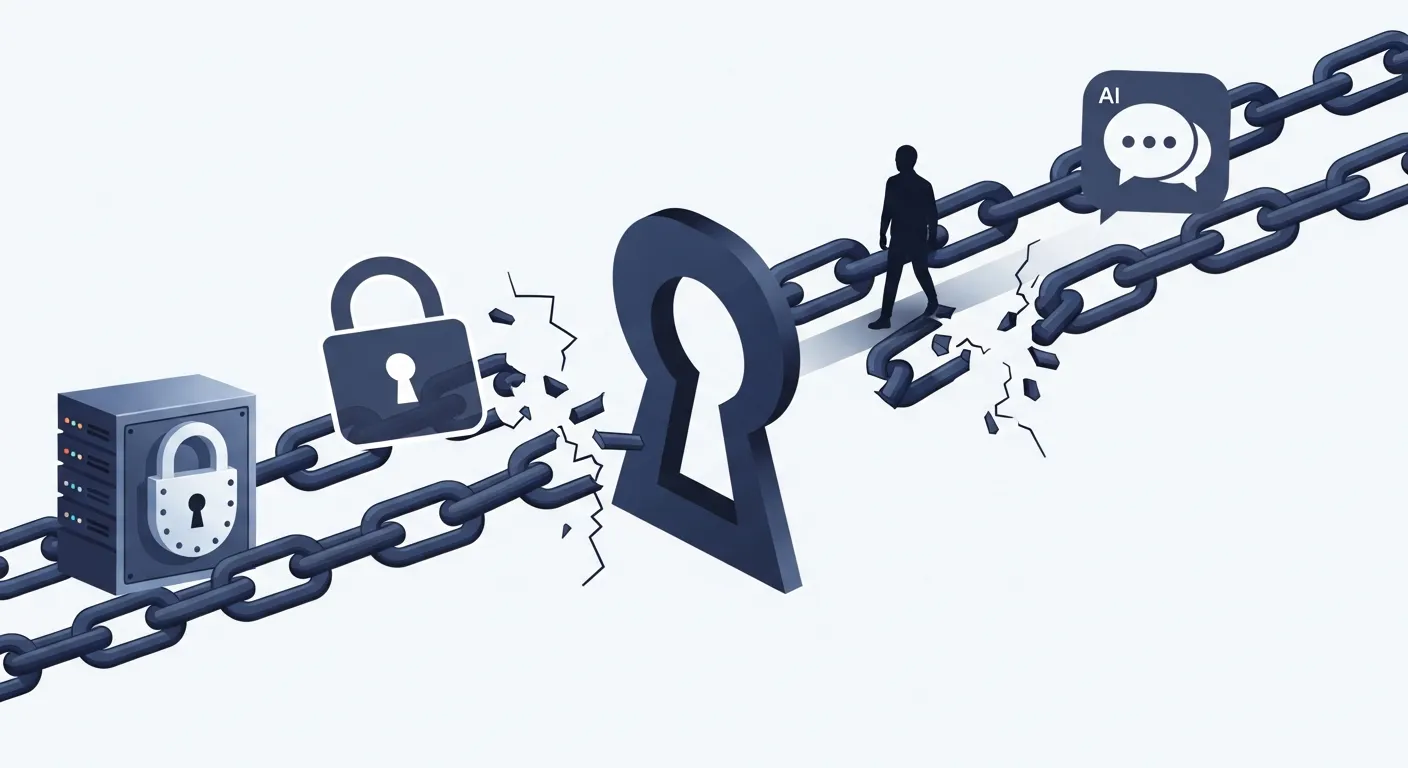
The incident shows a chain that many teams have in some form:
- A third-party SaaS app gets OAuth access.
- The app is tied to a company identity provider.
- The identity provider grants access to employee accounts.
- The employee account can reach internal tools or admin surfaces.
- Internal tooling can expose secrets or deployment controls.
Once that chain exists, one weak link can pull the rest with it.
Employee account takeover and pivot risk
If an attacker gets into an employee workspace account, the question is not just “can they read mail?” It is “what else is attached to this identity?”
Treat the following as pivot points:
- SSO sessions
- admin dashboards
- deployment consoles
- support tooling
- internal chat integrations
- automation bots with broad scopes
A single compromised employee account is often enough to enumerate the environment and find the real prize.
Why decryptable environment variables mattered
Vercel's bulletin called out non-sensitive environment variables that decrypt to plaintext. That is the part teams should read closely.
If an environment variable can be read by a human or by a compromised workflow, it is not harmless just because it lives in a platform. API keys, database credentials, signing keys, and tokens all become recovery targets.
The defensive takeaway is simple: assume anything readable by the platform may be exposed if the platform account or a trusted integration is compromised.
What Vercel confirmed and what it ruled out
Vercel said it worked with GitHub, Microsoft, npm, and Socket and found no evidence that npm packages published by Vercel were compromised. That distinction matters because supply-chain rumors spread fast after incidents like this.
No evidence of npm package tampering
The bulletin explicitly says there was no package tampering and that the supply chain remained safe. So if you were looking for a poisoned package story, this was not it.
That makes the incident more useful, not less. It shows how much damage can happen without touching package registries at all.
Separate suspicious accounts versus the April incident
Vercel also said it found a small number of additional accounts with signs of compromise that appeared separate from the April incident and not originating on Vercel systems.
That distinction matters for incident response. If you blur separate compromise paths together, you end up rotating the wrong secrets, chasing the wrong logs, and missing the real exposure window.
How to test your own OAuth and secret handling
Inventory connected apps and OAuth scopes
Start with a full inventory of connected apps in Google Workspace, GitHub, Slack, and any SSO-backed SaaS.
For each app, ask:
- Who approved it?
- Which scopes does it have?
- Is it still used?
- Does it have access to mail, files, deployment systems, or admin APIs?
- Can an employee install it without review?
A good control here is boring: make app review explicit and periodic.
Check for environment variables that should be treated as exposed
Make a list of every environment variable that can influence production:
- database credentials
- signing keys
- third-party API keys
- webhook secrets
- session secrets
- deployment tokens
Then sort them into two buckets:
- values that should be considered non-sensitive but still monitored
- values that must be rotated if an admin or integration is compromised
If a secret is only safe because it is “in the platform,” you do not actually have secret handling. You have secrecy by convenience.
Review activity logs and recent deployments
Vercel recommended checking activity logs and recent deployments. That is the right place to look.
You want to know:
- Were there unusual logins?
- Were environment variables read unexpectedly?
- Did someone create or change deployments outside normal release windows?
- Were deployment protection tokens used from new locations or agents?
If the answer is unclear, assume the account path is dirty until proven otherwise.
Practical defenses for AI SaaS integrations
MFA, passkeys, and admin review
Enable MFA everywhere, but do not stop at MFA. Passkeys and authenticator-based flows reduce the chance that one stolen session unlocks the whole chain.
For SaaS apps used by employees:
- require admin approval for new OAuth apps
- review high-risk scopes manually
- disable unused integrations
- enforce sign-in protections on sensitive accounts
Sensitive secret storage and rotation discipline
Vercel recommended its sensitive environment variable feature. That is the right direction, but it only helps if teams classify secrets correctly.
Rotate first, ask questions later, when:
- an account with deployment access is compromised
- a trusted third-party app is compromised
- secrets may have been readable in plaintext
- a token was stored in a place that should never have exposed it
Deployment protection and token rotation
If your deployment platform has protection tokens, rotate them after suspicious access. Also make sure deployment protection is set to a standard or stronger control level.
The mistake is keeping a powerful token alive because “nothing happened to prod.” By the time something happens to prod, it is too late to treat token rotation as optional.
What the incident changes for teams using AI tools
AI SaaS tools often sit close to the most sensitive parts of the stack: inboxes, docs, tickets, code, deployments, and cloud consoles. That makes them useful, but it also makes their OAuth posture part of your security boundary.
I would treat every connected AI tool as if it could become an identity pivot. If it can read workspace data, it can become a stepping stone to admin access. If it can touch operational systems, it can become a recovery path for secrets.
The operational rule is blunt: trust the workflow less than the scope, and trust the scope less than the account that can approve it.
Conclusion
The Vercel incident is a good reminder that “third-party app compromise” is not a side note. It can become identity compromise, then internal access, then secrets exposure, all without touching your codebase.
If you only test for package tampering or direct application bugs, you will miss this class of failure. The better test is to follow the OAuth grant, the account boundary, and the secret read path end to end.
If one connected tool can reach your workspace, your deployments, and plaintext secrets, then it is part of your production trust model whether you documented it or not.