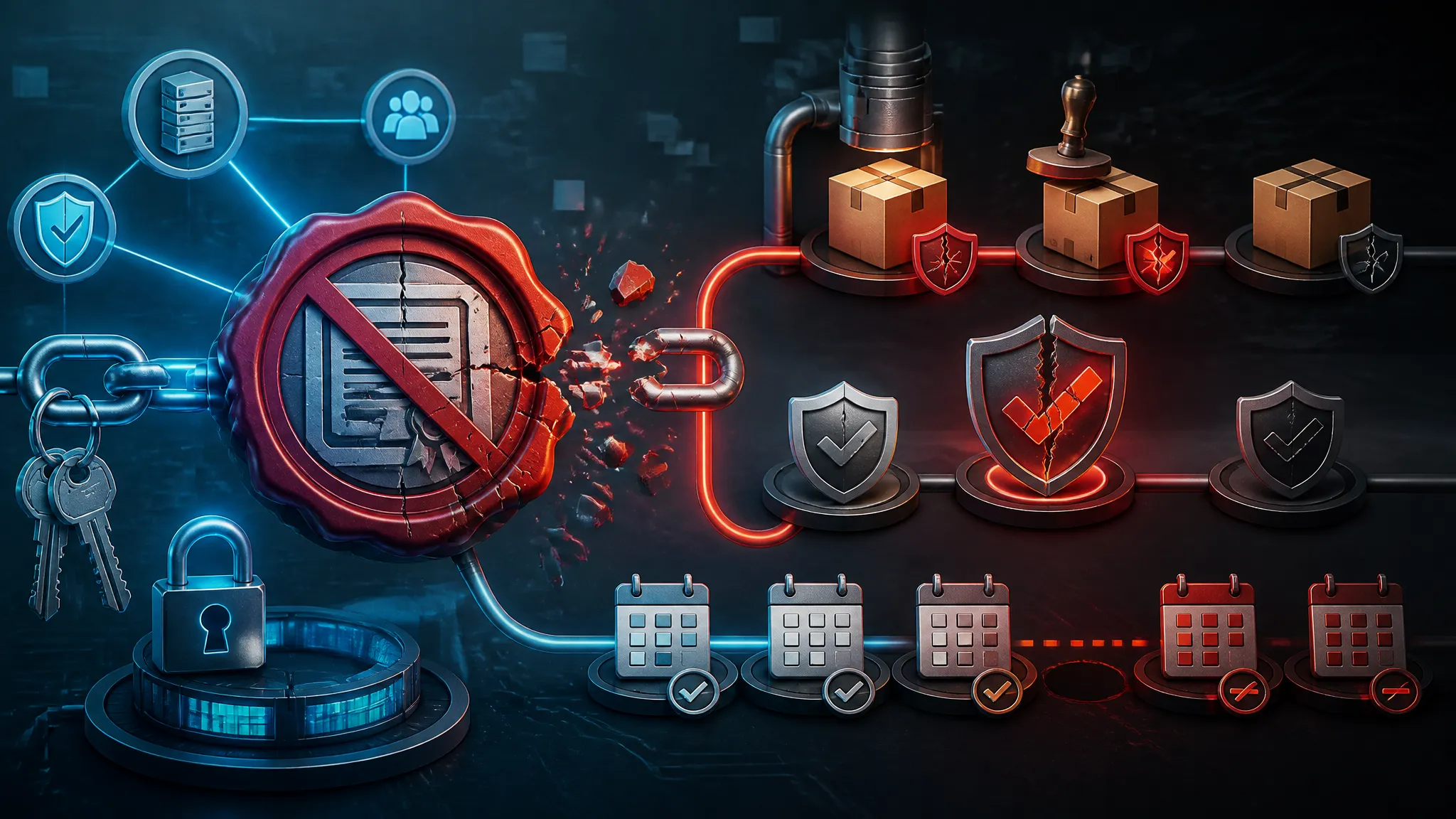
Certificate Revocation Is a Release-Engineering Problem, Not a PKI Team Problem
Introduction
A Linux distribution pushed its release date because of a root certificate. If you own a build pipeline, that sentence should make you flinch: a third-party trust anchor was sitting on the critical path between feature freeze and a downloadable ISO, and nobody noticed until it fired. This post traces how a CA revocation reaches Fedora-style build pipelines, separates what the public report establishes from what remains inference, and gives you checks you can run before a trust-store change becomes a schedule slip.
My position: certificate revocation is a release-engineering problem, not a PKI-team problem. The PKI team produces a decision ("this root is no longer trusted") and a date. Everything after that — rebuilding buildroots, re-signing artifacts, re-running validation, moving Go/No-Go — belongs to whoever owns the release. Teams that treat ca-certificates as an OS file that quietly updates itself at runtime will keep discovering it's a build input, usually at the worst possible moment.
What the public record actually establishes
Confirmed from the source
The report published by news.lavx.hu on 23 October 2026 states two things:
- Fedora 45's release moved to November 2026.
- The stated cause was an eMudhra certificate authority incident that forced mass revocation.
That's the entire confirmed set. No CVE, no advisory ID, no list of affected roots, no enumeration of rebuilt artifacts, and nothing about which packages or images were touched.
What the report does not confirm about the revocation mechanism
The report doesn't say whether remediation was root removal from the trust store or per-certificate revocation via CRL/OCSP. Those have different downstream shapes: root removal changes the bundle your build chroots download, while per-certificate revocation changes what a verifying client accepts at runtime. If someone tells you which happened, ask for the primary document.
Also unconfirmed, and worth flagging as unlikely: that Fedora's package signing keys were affected. Fedora signs RPMs with GPG keys managed through its own signing infrastructure, not with X.509 certificates chained to a public CA. A CA removal doesn't invalidate an RPM signature — exactly the distinction that gets lost in the incident chatter. Treat that as inference, not as a sourced claim.
The one thing the timeline does support: a slip measured in weeks, not months, fits re-running composes and re-validating artifacts rather than re-architecting anything. That's my reading of the schedule, not a statement from the report.
How a CA revocation reaches a distro build pipeline
The CA bundle is a build dependency, not just a runtime file
On Fedora-family systems, ca-certificates ships the source anchors, and update-ca-trust extracts them into the bundles that TLS libraries actually read:
$ ls /etc/pki/ca-trust/extracted/pem/
tls-ca-bundle.pem  email-ca-bundle.pem  objsign-ca-bundle.pem
Anything that consumes tls-ca-bundle.pem at build time inherits the revocation — a wider set than most inventories capture:
- package managers fetching over HTTPS inside a buildroot (
dnf,pip,npm,go mod download,cargo) - artifacts that bake in a trust store: container base images, Java
cacerts, Node images, installer and live media - verification steps that chain to a public CA — RFC 3161 timestamp countersignatures, Authenticode, keyless signing via Fulcio
CA certificates and package signing keys are different anchors that get conflated
These are separate systems with separate failure modes, and incident response that merges them burns time on unnecessary work.
| Verification | Anchor type | Effect of a CA root removal |
|---|---|---|
rpm --checksig pkg.rpm | Distro GPG key | None — signature still valid |
gpg --verify on a release tarball | Maintainer GPG key | None |
openssl verify -CAfile bundle.pem leaf.pem | Public CA hierarchy | Fails if the chain touches the removed root |
| RFC 3161 timestamp validation | Public CA hierarchy | Can fail even though the artifact is untouched |
| Keyless/cosign verification | Fulcio root + TUF root | Fails only if the Fulcio chain is affected |
The dangerous row is the timestamp one: revocation can invalidate the evidence around an artifact without changing the artifact itself. That's a verification problem, not a rebuild problem, and it deserves its own runbook.
How a revocation cascades from trust store to release date
From revocation to rebuilt buildroot
The chain that actually blocks a release, in order:
- Upstream publishes the removal; the distro's
ca-certificatesmaintainer bumps the package. - A new buildroot is composed with the updated bundle.
- Every package build that fetched anything over TLS during
%buildor%prepnow runs against a different trust set. If bootstrap isn't hermetic, the inputs to the build changed, so reproducibility checks flag it. - Container base images rebuild, then every layered image on top.
- Installer, live, and cloud images rebuild — large, slow, and validated as a set.
- Artifacts re-sign and re-checksum.
- The QA matrix re-runs against the new compose.
Steps 3 and 4 are where the time goes, because each is a fan-out you can't shortcut without shipping an artifact whose trust inputs you can't describe.
From rebuilt buildroot to a moved release date
Once a compose is invalidated after a freeze, the schedule stops belonging to engineering. Go/No-Go has to happen again, release notes have to be regenerated, mirror staging slots may need re-booking, and any downstream consumer that validated an RC has to re-validate. A two-to-three-week slip is the honest cost of that, and it matches what the report describes.
A reproducible revocation-readiness check
Run this against a representative build host, not your laptop. The goal is a number you can put in front of a release manager.
Enumerate what actually trusts public CAs
## How many anchors does the system trust today?
trust list --filter=ca-anchors --format=pem-bundle > /tmp/anchors.pem
grep -c "BEGIN CERTIFICATE" /tmp/anchors.pem

## What declares a dependency on the bundle package or its extracted files?
rpm -q --whatrequires ca-certificates
rpm -q --whatrequires /etc/pki/ca-trust/extracted/pem/tls-ca-bundle.pem

## Inside a buildroot, what pulls TLS in transitively?
dnf repoquery --whatrequires ca-certificates --recursive --qf '%{name}\n' | sort -u | wc -l
Your counts will differ from any number quoted in a blog post; what matters is having a baseline you can diff. Save the sorted output to git and re-run it whenever the bundle version changes.
Time a trust-store change in a scratch channel
The useful measurement is the ratio between a warm rebuild and a cold one, because the cold path is what a revocation forces.
set -euo pipefail

## One-off: remove a throwaway root from a scratch image and see what breaks.
podman build -t localhost/trust-probe -f Containerfile.trust .

for i in 1 2 3; do
podman rmi -f localhost/trust-probe >/dev/null 2>&1 || true
/usr/bin/time -f "cold run %e s"   podman build --no-cache -t localhost/trust-probe -f Containerfile.trust .
done

## What did the change actually touch inside the image?
podman run --rm localhost/trust-probe sh -c 'trust list --filter=ca-anchors | grep -c "^pkcs11:id"'
Record three numbers: cold build wall-clock, count of affected packages, and count of steps that needed a human. That third number is the one that predicts your slip.
Separate repeatable prerequisites from one-off dependencies
| Bucket | Examples | Automation status |
|---|---|---|
| Repeatable | bundle bump, buildroot recreate, image rebuild, checksum refresh | Must be one command each |
| Repeatable but slow | ISO/live/cloud image builds | Run on a nightly schedule, not at freeze |
| One-off | re-signing ceremony, mirror re-booking, release-note rewrites | Named owner required |
| Manual and undocumented | "ask the person who knows the compose flags" | Release blocker |
Anything in the last row is why a CA incident becomes a schedule event.
What to automate before the incident
Inventory and blast-radius mapping
Generate the trust inventory on a schedule and commit it. The audit question you must be able to answer is: which artifacts did we build while this root was trusted? That requires build timestamps plus a record of the bundle version baked into each artifact. If you can't answer it, you can't scope a revocation — you can only rebuild everything, which is the expensive option taken under time pressure.
A rehearsed bundle rollback path
Removing a root breaks things. Ship the rollback before the removal:
sudo dnf downgrade ca-certificates
sudo update-ca-trust extract
openssl verify -CAfile /etc/pki/ca-trust/extracted/pem/tls-ca-bundle.pem cert.pem
update-ca-trust extract is idempotent, so a rollback is a package downgrade plus one command. Rehearse it in a scratch channel. Don't discover during an incident that your golden image hardcodes an extracted bundle.
Don't "fix" a revocation-induced build failure with --nogpgcheck, sslverify=false, or NODE_TLS_REJECT_UNAUTHORIZED=0. That converts a visible trust change into silent, permanent trust in everything.
Offline and pinned-trust build modes
Hermetic builds are the real mitigation: if a build can't reach the network, a trust-store change can't alter its inputs.
- Use
mockwith a pre-populated--installrootand--disablerepofor anything on the release path. - Vendor dependencies and pin checksums rather than fetching during
%build. - In Node tooling, make CA trust explicit instead of ambient:
NODE_EXTRA_CA_CERTSfor additional anchors,--use-openssl-cawhere the system store is the intended source, andtls.createSecureContext({ ca })when a service must pin a specific hierarchy. For internal registries,npm config set cafile <bundle>beats disabling verification. - For sigstore/cosign verification, pin the Fulcio root and TUF root you trust, and verify with
--offlinewhere transparency log proofs are cached — so a public-CA event can't silently swap your verification root.
Signing key custody kept independent of CA trust
GPG signing keys and X.509 CA trust must not share a rotation event. Keep release signing keys in an HSM or dedicated signing service, with a documented rotation procedure triggered by key compromise only — never by a CA decision. If you do use X.509-based signing (Authenticode, keyless), document explicitly that a CA revocation can force re-signing, and give that its own alert path.
What is still unconfirmed and what would resolve it
Three things would turn this post's inferences into facts, and each changes the response:
- The primary advisory. A Fedora devel-announce or security advisory naming the affected certificates and the remediation mechanism would tell you whether this was root removal or per-certificate revocation. If per-certificate, runtime clients were the exposure; if root removal, build pipelines were.
- The CA's own incident statement. eMudhra's disclosure would establish scope and whether misissuance was involved.
- A CCADB record or root-store policy decision. A Mozilla root store removal record would fix the date the change landed upstream, which is the input to every downstream schedule.
Until those exist, treat the mechanism as unknown. The readiness work above doesn't depend on the answer.
Conclusion
The uncomfortable lesson isn't that a CA can be distrusted — that part is the system working. It's that most organizations can't say which of their artifacts were produced under a trust anchor that has since been withdrawn, so their only safe response is a full rebuild, and a full rebuild after freeze is a schedule slip.
Make the bundle a versioned, inventoried build input. Keep signing keys off the CA trust graph. Rehearse the rollback. Then a revocation becomes a two-day release-engineering job with a known owner instead of a release date moving to November.
Further Reading
- Mozilla Root Store Policy — the policy text governing root inclusion and removal.
- CCADB — the Common CA Database where root store changes are recorded.
- RFC 5280: Internet X.509 PKI Certificate and CRL Profile — revocation semantics.
- RFC 3161: Time-Stamp Protocol — why timestamp validation can break when a CA does.
- Node.js TLS documentation — trust store selection,
NODE_EXTRA_CA_CERTS, and secure context options. - Sigstore documentation — keyless signing roots and offline verification.