Auditing Cloud Workloads for Grid Impact: The Bit2Watt Attack and Developer Defenses
The Bit2Watt headline is interesting because it does not point to memory corruption, a malformed packet, or a browser exploit. It points to a trust-boundary failure: a cloud tenant appears able to influence power-grid-adjacent behavior through systems that trusted tenant-originated signals too much.
That distinction matters. If the report is accurate, the real issue is not “someone popped a server.” The issue is that a legitimate account could drive an operational effect that should have required stronger identity, stronger authorization, or both. That is a different failure class, and it needs a different review process than the one most teams reach for when they only scan for CVEs.
Bit2Watt is a trust-boundary problem, not a classic remote-code-execution bug
What the reporting says about the attack model
The only confirmed detail I can rely on from the source material is the headline and summary: a report published on 2026-07-21 by The Hacker News says the “Bit2Watt” attack could let cloud tenants disrupt power grids “without an exploit.”
That phrasing matters. It suggests the attacker may not need:
- code execution on the provider side,
- a parser bug,
- or a direct compromise of the grid operator.
Instead, the attack likely depends on abusing a legitimate interface, workflow, or data path that already exists between a tenant workload and an operational system.
That is not a minor nuance. It changes the engineering question from “what patch fixes the bug?” to “what trust assumptions let tenant-controlled data become operational truth?”
Why the phrase “without an exploit” should change how developers think
When people hear “no exploit,” they often hear “not a security bug.” I think that is the wrong takeaway.
A lot of real failures happen without classic exploitation:
- the UI exposes a dangerous action to the wrong role,
- the API accepts a client-controlled field that should be server-owned,
- telemetry is treated as authoritative when it is only advisory,
- a shared control channel mixes tenants that should have been isolated,
- an automation job does exactly what it was told, but no one checked who was allowed to tell it.
In other words, this is likely a business-logic and authorization problem, not a buffer-overflow problem.
That should push developers toward abuse-case reviews. If your system can affect physical infrastructure, or anything that ultimately feeds a physical system, then “the request is syntactically valid” is not a meaningful security guarantee.
Where cloud tenancy meets grid operations
The data flow from tenant workload to operational signal
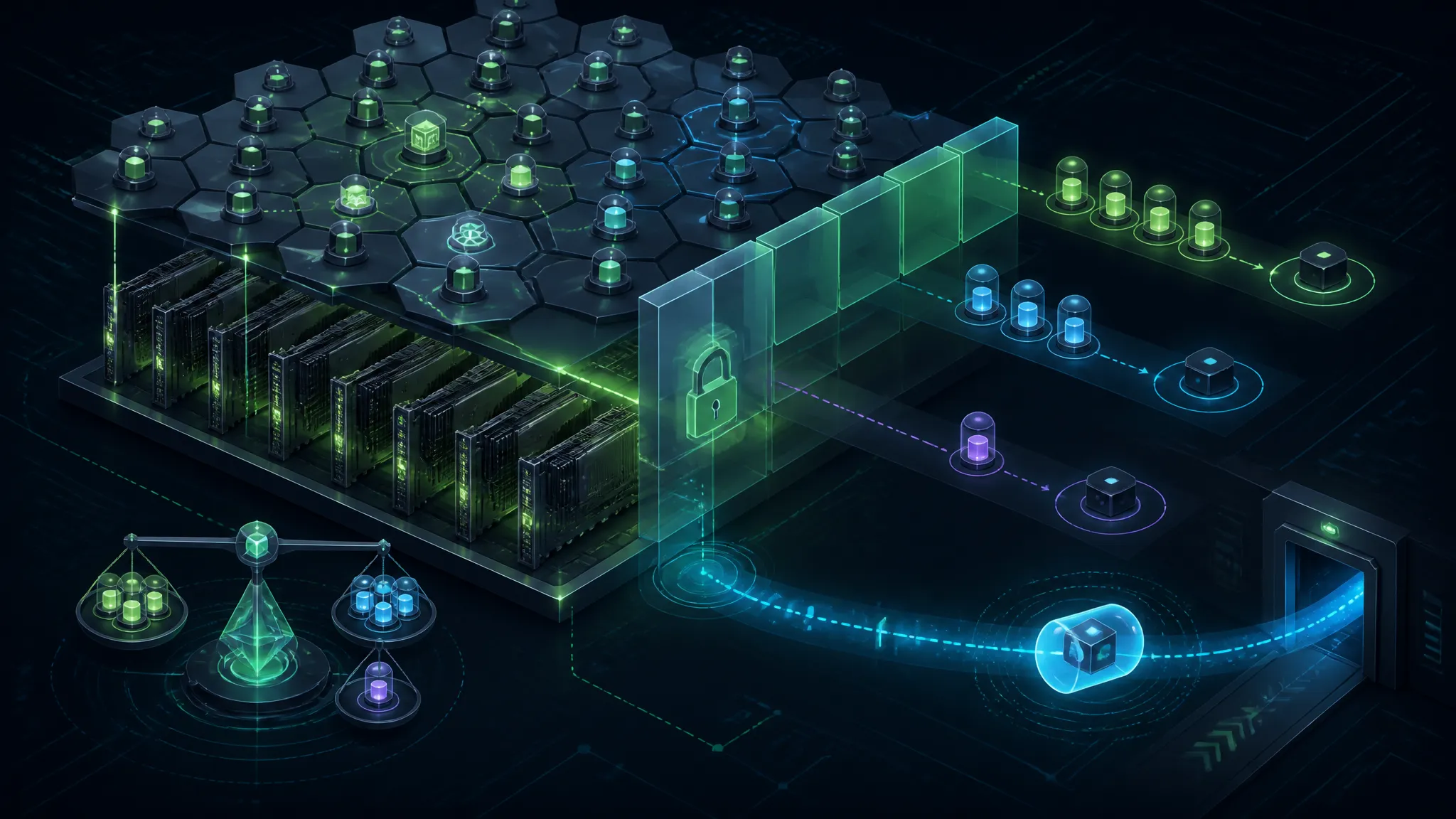
I would model the risky path like this:
- A tenant workload generates data: telemetry, demand estimates, usage reports, scheduling hints, maintenance events, or job metadata.
- That data crosses a service boundary into a provider-controlled system.
- A downstream service turns the data into an operational signal.
- Another service consumes that signal and changes behavior in the real world.
The dangerous step is step 3. Once software converts tenant-supplied input into a control-plane decision, the input stops being “just data.”
A typical architecture might include:
- a SaaS dashboard for energy or infrastructure management,
- an API that records load forecasts or job priorities,
- an internal queue that fans out operational events,
- an automation service that triggers actions based on thresholds,
- and a grid-facing integration that consumes those actions.
If any layer treats tenant-originated information as authoritative without checking ownership, role, time window, or provenance, you have a control-bypass problem waiting to happen.
Which assumptions are usually implicit but dangerous
The assumptions I would challenge first are the ones teams rarely write down:
- “If the request came from a valid account, it must be allowed.”
- “If the dashboard shows the value, the backend must already have validated it.”
- “If the telemetry was signed by our service, it must have come from a trusted tenant.”
- “If the action is automated, it is safe because humans are not involved.”
- “If the data was produced inside the platform, it is trustworthy.”
Those assumptions are convenient. They are also exactly what an attacker wants.
The report headline implies a tenant can do damage without a technical exploit, which means the failed boundary was probably procedural or architectural. That is the part developers need to inspect.
What would make this attack possible in practice
Weak identity and authorization checks between tenants and grid-facing services
The simplest failure mode is bad authorization.
A tenant may be allowed to submit forecast data, but not to create a grid-impacting event. If the backend does not distinguish those actions, a tenant can submit a value that drives the wrong downstream decision.
This is the same shape as the classic “I can edit my own order, so I can edit your order” bug, except the consequence is operational rather than financial.
A minimal backend check should look more like this than a client-side gate:
function authorizeGridAction(req, action) {
  if (req.user.tenantId !== action.tenantId) {
    throw new Error("forbidden");
  }

  if (!req.user.roles.includes("operator")) {
    throw new Error("forbidden");
  }

  if (!action.approvedByBackend) {
    throw new Error("forbidden");
  }
}
The important part is not the syntax. It is the location. The decision belongs at the backend boundary, where the trusted system owns identity, tenancy, and policy.
Over-trusting telemetry, job metadata, or shared control channels
A second failure mode is treating telemetry as if it were a command channel.
Telemetry is often messy, delayed, and only partly trusted. If it becomes the trigger for automation, then a tenant can potentially manipulate the trigger conditions by shaping load, timing, or metadata.
I would pay special attention to:
- job names or labels that get copied into workflow rules,
- queue messages whose fields are parsed by downstream automation,
- status events that are accepted without provenance checks,
- and multi-tenant channels where one actor can influence thresholds seen by another.
The risk here is not always “steal data.” Sometimes the risk is “change the system’s state machine.”
Business logic abuse versus technical compromise
This class of issue is best thought of as business logic abuse.
That matters because mitigations differ:
- RCE gets patching, hardening, sandboxing, and exploit prevention.
- Business logic abuse gets policy enforcement, ownership checks, audit trails, and safe defaults.
A service can be technically stable and still unsafe if it accepts the wrong kind of input from the wrong principal.
That is why “no exploit” should not reassure anyone. A tenant who can legitimately call the API may still be able to cause unauthorized effects if the API’s semantics are too broad.
How I would test a cloud workload for this class of failure
Reproduce the request path with a safe tenant account
I would start with a tenant account that is intentionally low privilege and fully authorized for testing.
Then I would trace one action end to end:
- Trigger the workflow from the dashboard or API.
- Capture the request.
- Replay it with controlled changes.
- Compare backend behavior.
For example:
curl -i https://api.example.test/v1/operations \
  -H "Authorization: Bearer $TOKEN" \
  -H "Content-Type: application/json" \
  --data '{"tenantId":"tenant-a","action":"schedule","loadKw":1200}'
What I would look for is not just 200 OK. I would look for whether the backend accepts a modified tenantId, role, priority, or targetRegion field that the user should not control.
If the server returns something like this, that is a warning sign:
HTTP/1.1 200 OK
Content-Type: application/json

{"status":"accepted","operationId":"op_18372","effectiveTenant":"tenant-b"}
That would mean the backend is trusting a client-controlled field or silently remapping identity in a way the client can influence.
Trace which fields are client-controlled versus server-enforced
A useful test table looks like this:
| Field | Should the client control it? | What to verify |
|---|---|---|
tenantId | No, usually server-owned | Reject mismatches with authenticated identity |
role | No | Derive from auth claims or policy service |
priority | Maybe, if bounded | Enforce per-tenant limits |
target | Usually no | Restrict to authorized scope |
timestamp | Sometimes | Validate freshness and replay resistance |
loadKw | Maybe, if advisory | Compare against historical and policy constraints |
If the UI hides a field but the API still accepts it, the UI is not a control. It is decoration.
Look for observable impact in logs, queues, or downstream automation
I would not stop at request/response testing. The interesting damage often shows up one layer deeper.
Check:
- queue messages created by the request,
- workflow transitions,
- audit logs,
- alerting rules,
- and any automation that consumes the event.
Useful commands are usually boring ones:
kubectl logs deploy/control-plane --since=30m | grep -E 'tenant-a|operationId|schedule'
or, if you have queue visibility:
aws sqs receive-message \
  --queue-url "$QUEUE_URL" \
  --max-number-of-messages 10 \
  --attribute-names All
The goal is to verify whether a low-privilege tenant can produce an event that looks operationally valid to downstream systems.
Defensive checks developers should add first
Enforce authorization at the backend boundary, not in the UI
The UI should not be your security layer.
If a browser can hide the “grid action” button, a user can still call the API directly. So the backend must enforce the rule.
The first fix I would ship is simple:
- authenticate every request,
- derive tenancy from the session or token,
- reject client-supplied identity fields,
- and make dangerous actions fail closed.
If the operation has physical side effects, the server should require an explicit authorization path for that side effect, not just a general login.
Bind operational actions to verified identity, tenancy, and role
A good pattern is to separate:
- who sent the request,
- which tenant owns the data,
- what role is allowed to act,
- and whether the action is within an approved operating window.
If you need a control-plane action, require all four.
That gives you room to reject abuse even when the request is syntactically valid.
Add rate limits, anomaly detection, and circuit breakers for control-plane actions
Even a correctly authorized request can still be dangerous at scale.
I would add:
- per-tenant and per-role rate limits,
- anomaly detection on unusual action frequency,
- circuit breakers that pause automation when inputs drift,
- and manual approval for high-impact operations.
This is especially important when an API can influence physical systems. The safest system is the one that can slow itself down when input quality drops.
What platform operators should monitor during incident response
Signals that suggest tenant-driven manipulation rather than a software bug
If you are investigating this kind of issue, I would look for patterns like:
- the same tenant repeatedly triggering edge-case values,
- requests that are valid but operationally unusual,
- many low-impact actions that collectively create a high-impact state,
- telemetry changes without matching user intent,
- and control actions that originate from accounts that should only read data.
That pattern often looks less like malware and more like policy abuse.
Containment steps that reduce blast radius without shutting down the service
I would start containment with the least disruptive steps:
- Freeze the specific automation path, not the entire platform.
- Move high-impact actions to manual approval.
- Quarantine the tenant or workload that appears abusive.
- Preserve queue contents, audit logs, and request traces.
- Narrow downstream permissions until the trust chain is understood.
The goal is to reduce operational risk while preserving evidence.
What is confirmed, what is inferred, and what still needs primary-source validation
Facts stated in the public report
Confirmed from the source material:
- A report published by The Hacker News on 2026-07-21 discussed an attack called Bit2Watt.
- The headline claims the attack could let cloud tenants disrupt power grids.
- The headline also says this could happen “without an exploit.”
That is all I can confirm from the provided material.
Inferences about likely abuse paths
These are my inferences, not confirmed facts:
- The attack likely depends on trust-boundary abuse rather than code execution.
- Tenant-controlled telemetry or job metadata may be part of the path.
- A backend service may be converting advisory data into operational action too early.
- Weak authorization between tenant services and grid-facing systems is a likely root cause class.
Those are plausible based on the wording, but they still need primary-source validation.
Open questions the current reporting does not answer
The source material does not tell us:
- which cloud provider or workload type is involved,
- whether the issue affects one vendor or a general class of systems,
- what specific operational signal is manipulated,
- whether the effect is automatic or requires human approval,
- or what controls would have stopped it.
Until those details are public, I would treat any deeper claim as unverified.
The practical takeaway: grid-adjacent cloud systems need abuse-case reviews, not just vulnerability scans
Where to put the next review in a real engineering process
If I were reviewing a cloud system that can influence grid operations, I would add an abuse-case review before launch and after every major integration change.
Put the review at these points:
- when a new tenant-facing telemetry field is added,
- when an automation rule starts consuming tenant data,
- when an API is exposed to multiple tenants,
- when a workflow can trigger external operational actions,
- and when a control channel crosses from “informational” to “authoritative.”
My position is simple: if a cloud workload can affect grid-adjacent behavior, then the security review must ask who is allowed to cause the action, not just whether the request is valid.
That is the lesson I would take from Bit2Watt. The interesting failure is not that a bug existed. It is that a legitimate boundary was trusted too much.
Share this post
More posts

From Exposed RDP to Domain Encryption: Auditing Your Stack Against the Conti Playbook

Distillation Discount: How DeepSeek’s 75% Price Cut Exploits the Race to the Bottom in AI APIs